
Tungsten Carbide Patents Signal Supply Rule Shift
On June 16, 2026, Zhangyuan Tungsten received two core patents for tungsten carbide powder, a development that matters beyond product technology because it aligns more closely with current compliance and procurement expectations in overseas hard alloy supply chains. The event is worth industry attention because lower-temperature production, lower free carbon, and higher consistency can affect how exporters, buyers, processors, and compliance teams assess delivery stability, REACH-related suitability, and low-carbon-footprint sourcing requirements in the EU and North American markets.
What Was Confirmed on June 16
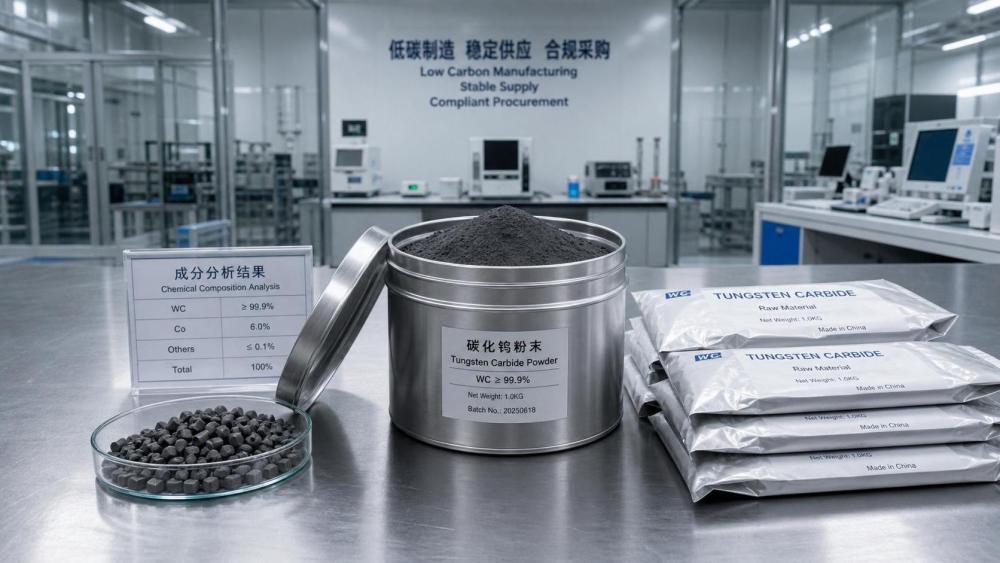
According to the information provided, Zhangyuan Tungsten was granted two tungsten carbide powder patents on the same day: CN121948455B and CN121929699B. The two patented routes cover ultrafine powder with a specific surface area of 2.0–3.0 m²/g and medium-particle powder at 5.0–6.0 µm.
The disclosed outcome is low-temperature preparation with low free carbon and high consistency. The summary also states that both technologies significantly reduce energy consumption and dependence on reagents, while improving the stability of export delivery for tungsten carbide powder.
The confirmed market-facing implication in the provided summary is that this is particularly favorable for procurement demand from EU and North American customers seeking REACH-compliant and low-carbon-footprint raw materials.
Why This Matters in Cross-Border Supply Chains
For export sellers, the focus shifts from price alone to document-backed consistency
From an industry perspective, exporters may be affected because overseas buyers increasingly evaluate not only material availability but also whether technical performance can be matched with compliance-facing documentation. In this context, attention is likely to center on material specifications, consistency records, and supporting statements related to REACH suitability and carbon-footprint expectations during quotation, contracting, and shipment preparation.
For overseas buyers, sourcing criteria may move closer to compliance-linked procurement
Buyers of hard alloy raw materials may be affected because the reported advantages are not limited to production efficiency; they also relate to delivery stability and lower-carbon sourcing preferences. What deserves closer attention is whether procurement reviews, supplier onboarding, and technical specification alignment place greater weight on low free carbon, batch consistency, and supporting compliance materials.
For processors and manufacturers, feedstock stability becomes a practical operating issue
Processing and manufacturing users may be affected where powder grade stability directly influences downstream production control. The practical impact is likely to appear in raw material qualification, incoming inspection standards, technical file review, and traceability management, especially where overseas customer requirements are embedded into production or tender specifications.
For testing and compliance-facing service providers, evidence quality may matter more
Certification-related firms and testing service providers may also see greater attention on how product characteristics are evidenced in reports and technical documents. Analysis shows that the key issue is not the existence of a patent alone, but whether supporting records, test data formats, and material descriptions can satisfy customer review processes tied to compliance and delivery assurance.
What Companies Should Watch Next
Check whether technical files match procurement language
Companies involved in export or sourcing should closely review whether product descriptions, specifications, and supporting technical documents clearly reflect the characteristics identified in the granted patents. This is particularly relevant where customer purchasing language refers to consistency, free carbon control, or lower-carbon raw material preferences.
Track how REACH-related review is reflected in transactions
Observably, the summary connects the patented products with demand from EU and North American customers for REACH-compliant and low-carbon-footprint materials. Since no detailed execution outcome is provided, companies should treat this as a signal to monitor how compliance review, declarations, and supporting documentation are requested in actual orders rather than assuming a uniform market standard has already formed.
Reassess delivery planning and supplier qualification
Where procurement teams rely on imported or export-oriented tungsten carbide powder flows, it is reasonable to review supplier qualification criteria, delivery-cycle assumptions, and batch-traceability requirements. The practical question is whether higher consistency and lower reagent dependence translate into more stable execution at the contract and shipment level; this remains something to verify in ongoing business operations.
Prepare for closer scrutiny in tenders and customer audits
For companies participating in tenders or customer audits, attention should be paid to whether technical bid documents, test reports, and quality traceability materials need to address low free carbon, consistency, or low-carbon-footprint claims more explicitly. The current information does not confirm a formal rule change in tender wording, but it does indicate where buyer expectations may be moving.
How This Signal Should Be Read
Analysis shows that this development is better understood as an execution signal within industry rules rather than a standalone technology update. The reason is that the reported benefits connect directly to areas where supply chains are already sensitive: export delivery stability, REACH-related procurement suitability, and lower-carbon sourcing preferences.
At the same time, it is more appropriate to understand this as a market and compliance-oriented indicator than as proof of a fully settled new purchasing rule. The information provided does not establish new formal regulatory text, a new certification regime, or a binding trade measure. What it does suggest is that technical capability is becoming more tightly linked to how compliance and procurement requirements are evaluated in practice.
What the Market Can Reasonably Take From It
A neutral reading of this event is that patented improvements in ultrafine and medium-particle tungsten carbide powder now carry direct relevance for overseas compliance-facing procurement, especially where delivery stability and lower-carbon sourcing matter. For the industry, the practical value lies less in the patent grant itself and more in the possibility that product consistency and production-route characteristics will carry greater weight in cross-border transactions.
Current information supports treating this as a concrete market signal with compliance and trade relevance, while still leaving room for observation on how procurement language, customer audits, and execution standards develop afterward.
Basis of This Article
This article is generated from the user-provided news title, event date, and event summary. The analysis is limited to the confirmed information supplied: the June 16, 2026 patent grants, the two patent numbers, the ultrafine and medium-particle powder specifications, the reported low-temperature, low-free-carbon, and high-consistency preparation, and the stated relevance to export delivery stability and demand for REACH-compliant, low-carbon-footprint raw materials.
For events of this kind, commonly relevant source types may include official company announcements, regulatory publications, customs or trade authority information, industry association updates, standards documents, and reporting by established industry media. No specific official source link was provided in the input, so further verification remains necessary.
What still requires continued observation includes any later clarification of compliance interpretation, certification review practice, tender-document wording, buyer-side technical requirements, industry feedback, and how companies implement these requirements in actual supply and delivery arrangements.