
Huareal Precision Gains Turning Insert Patent
On June 16, 2026, Zhuzhou Huareal Precision received authorization for utility model patent CN224359376U covering a semi-finishing turning insert for steel parts. The update is worth watching for machining manufacturers, overseas end users, procurement teams, and production engineers because it points to a tooling design aimed at better chip control, stronger edge resistance, and a wider usable cutting-parameter window in batch production settings such as automotive components and energy equipment.
What the patent covers
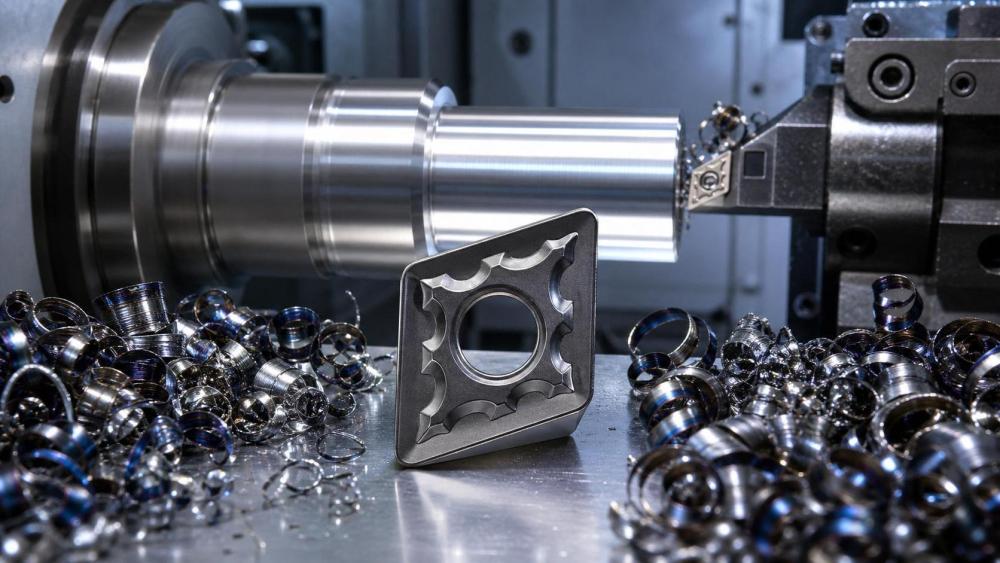
According to the provided information, the newly authorized patent relates to a steel-part semi-finishing turning insert. Its stated design focus is an optimized groove geometry combined with a gradual chip-pocket structure. The reported result is improved chip breaking performance and stronger resistance to edge chipping, allowing the insert to operate across a wider range of cutting parameters. The same information indicates that this can improve process robustness and changeover efficiency for overseas end users, while reducing stoppage and quality-inspection risks associated with long chips.
Where the impact may be felt first
Batch machining lines with stable output targets
From an industry perspective, machining manufacturers serving automotive components and energy equipment may be the first to pay attention because long-chip management directly affects line continuity. The potential impact is most visible in semi-finishing operations where parameter stability, downtime control, and repeatability matter more than isolated cutting performance claims. What deserves closer attention is whether a wider parameter window translates into easier setup across different part batches.
Overseas end users balancing output and quality risk
For overseas end users, the relevance lies in process robustness rather than patent ownership alone. Analysis shows that better chip breaking and stronger anti-chipping performance can matter in day-to-day production by lowering the risk of interruptions and inspection issues caused by uncontrolled chip formation. The business focus here is not only tool life, but also whether tooling behavior supports faster switching between jobs without adding instability.
Procurement and channel-side evaluation teams
Procurement teams, distributors, and other channel participants may also track this development because the value proposition is tied to usable process range. Observably, the main point to monitor is whether technical communication, qualification materials, and application guidance become more specific around steel semi-finishing scenarios, especially for customers that prioritize predictable delivery and fewer line stoppages.
What companies should monitor now
How the technical claim is positioned in application terms
Companies should focus on how the patent-protected design is described in actual application language: chip control, edge stability, and the breadth of cutting parameters are the key points already indicated by the provided information. The practical question is how these points are translated into process discussions with customers in steel semi-finishing work.
Which business links are most sensitive to chip-related stoppages
For manufacturers and service teams, the immediate attention point is where long-chip risk creates the highest operational cost. In the context provided, that means reviewing semi-finishing stages in volume production where downtime, quality checks, or changeovers are especially sensitive to unstable chip evacuation.
Customer communication around process robustness
Sales, application, and account teams should pay close attention to how customers define robustness. The provided information highlights broader cutting-parameter usability and reduced interruption risk, so discussions are likely to center on production consistency rather than on a single performance indicator.
Follow-up verification beyond the patent event
It is also important to distinguish between a patent authorization and broader market validation. Analysis shows that firms should continue monitoring subsequent official product positioning, application notes, or customer-side verification signals before treating the development as a fully established market outcome.
Why this reads as a process signal
As an editorial observation, this development is more appropriate to understand as a process-focused industry signal than as a stand-alone market conclusion. The patent authorization indicates that chip-breaking structure and edge-strength design remain central to tooling competitiveness in steel semi-finishing. At the same time, the current information does not by itself confirm commercial adoption scale, so the industry still needs to watch how the technical claim is carried into actual customer use.
How to read the development at this stage
On balance, the news matters because it links insert geometry design directly to practical production concerns: stoppage risk, quality consistency, and changeover efficiency in batch machining. A neutral reading is that this is a meaningful technical update with clear relevance to overseas machining users, but it is still best understood as a near-term operational signal and a longer-term point to monitor rather than a definitive shift on its own.
Basis of this article
This article is generated from the user-provided news title, event date, and event summary. Source types commonly relevant to developments of this kind may include official announcements, company disclosures, industry association information, authoritative media coverage, and standards-related documents. No specific official source link was provided in the input, so further verification remains necessary. Follow-up attention should focus on any later official technical descriptions, application updates, and market-side validation related to the patented insert design.