
TÜV Opens Self-Locking Nut Vibration Database
On June 17, 2026, TÜV Rheinland in Germany made its Self-locking Nuts Dynamic Torque Decay Database v2.0 freely available worldwide, bringing a large set of preload-loss data under high-frequency vibration into open industry use. For aerospace fastener teams, automotive bolt and nut suppliers, CAE users, procurement functions, and quality or validation personnel, the development is worth watching because it turns test data that is usually difficult to compare into a more accessible reference across standards, materials, coatings, and temperature conditions.
What Has Been Opened to the Market
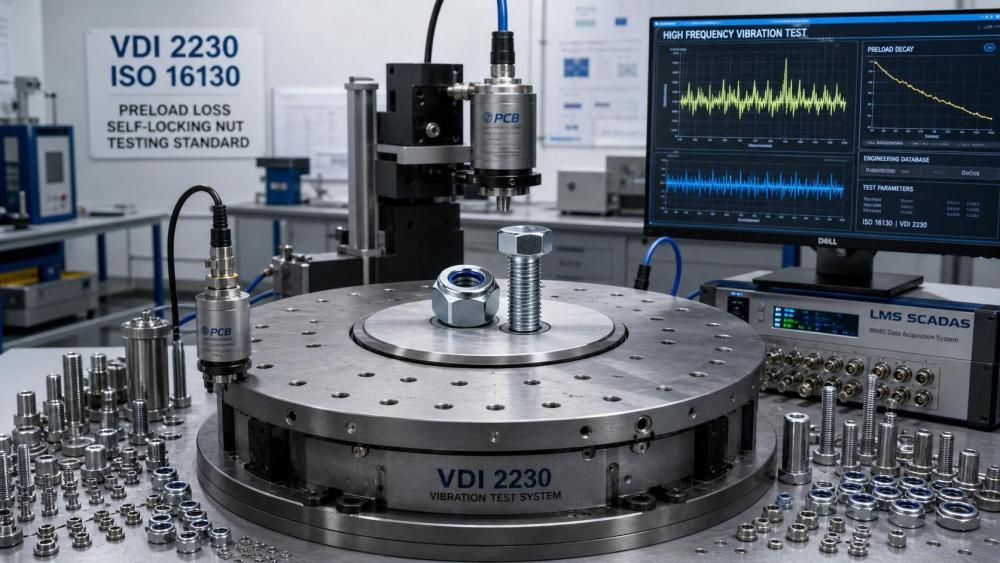
According to the disclosed information, TÜV Rheinland opened the Self-locking Nuts Dynamic Torque Decay Database v2.0 to global users on June 17. The database covers 120,000 sets of preload decay data collected under high-frequency vibration conditions from 10 to 2000 Hz.
The published scope includes 27 standards, including NASM13550, DIN 6921, and GB/T 3098.9. Users can filter the data by material, including Inconel 718 and TC4, by surface treatment such as Geomet and Dacromet, and by temperature from –55°C to 200°C.
The disclosed summary also states that the database has already been connected to interfaces used by mainstream CAE simulation platforms.
Where the Practical Impact May Appear First
Design and simulation workflows may see faster comparison cycles
From an industry perspective, engineering teams working on joint reliability may be among the first to feel the effect. Because the database is searchable by standard, material, coating, and temperature, design and CAE personnel may be able to compare preload decay behavior more directly during simulation setup or verification review. What deserves closer attention is whether internal design assumptions, especially around vibration-related retention performance, are still aligned with the newly accessible reference data.
Fastener manufacturers and processors may face closer technical scrutiny
For manufacturers of self-locking nuts, bolts, and related processed parts, the immediate impact is less about a rule change and more about a comparison benchmark becoming easier to access. Analysis shows that product, process, and quality teams may encounter more detailed questions from customers on standard coverage, coating routes, temperature conditions, and vibration performance references. The business link most likely affected is technical communication tied to qualification, quotation support, and validation documents.
Procurement and supply chain teams may need more precise specification control
For buyers, sourcing teams, and supply chain coordinators, the opening of a structured database may raise the bar for how fastening requirements are described and reviewed. Observably, when data can be filtered by specific material and coating combinations, purchasing discussions may move beyond part numbers alone toward clearer operating-condition matching. The change to watch is not only price or lead time, but whether supplier submissions can address the same parameter logic customers are now able to view more easily.
End-use sectors may gain a shared reference point across standards
Aerospace and automotive application teams may regard the database as a practical cross-reference tool because it spans multiple standards rather than a single regional system. Analysis shows that this matters most in projects involving multinational sourcing, platform comparison, or simulation-based review, where teams often need to interpret fastening performance across different specification backgrounds.
What Companies Should Watch Now
Check which internal parts map to the published standards
Companies using self-locking nuts should first identify whether their active or planned part families correspond to the 27 standards listed in the disclosed scope. This is a practical starting point for deciding whether the database can support engineering review, supplier communication, or customer-facing documentation.
Review parameter consistency in material, coating, and temperature assumptions
Because the database allows multi-dimensional filtering by material, surface treatment, and temperature, teams should compare those filters with their own drawing notes, qualification assumptions, and validation records. What deserves closer attention is whether the same part is being discussed internally under one set of conditions while customers or suppliers evaluate it under another.
Prepare for more data-based customer and supplier exchanges
For sales engineers, application support teams, and sourcing managers, the more immediate operational issue may be communication readiness. Analysis shows that once a free database is available, counterparties may ask more specific questions about vibration frequency range, preload decay behavior, or standard-specific applicability. Companies should be ready to respond with consistent technical references rather than broad product claims.
Separate database availability from formal requirement changes
It is more appropriate to understand this release as wider access to test and simulation-relevant information, not as a confirmed change in purchasing rules or mandatory qualification criteria. Firms should therefore distinguish between a new reference resource and any future changes in contractual, customer, or certification requirements.
Why This Looks Like a Data Accessibility Signal
Observably, this development says less about a sudden shift in fastener standards and more about the growing importance of accessible, filterable engineering evidence in fastening decisions. The fact that the database is free to global users and already connected to mainstream CAE platform interfaces suggests that data usability is becoming nearly as important as data ownership in technical evaluation workflows.
At the same time, Analysis shows that the industry should avoid reading the release as a finished market outcome. The disclosed information confirms access, scope, and filtering dimensions, but it does not by itself establish how individual customers, sectors, or approval systems will use the database in procurement or validation decisions. This remains an area to watch.
How This News Is Best Interpreted
At this stage, the update is best understood as a meaningful operating signal for engineering, sourcing, and quality functions rather than as an immediate structural change in the market. Its practical value lies in making vibration-related preload decay data easier to compare across standards and conditions, while its broader industry effect will depend on how actively companies integrate that resource into design review, supplier qualification, and technical communication.
Basis of This Article
This article is based on the user-provided news title, event date, and event summary concerning TÜV Rheinland's June 17, 2026 opening of the Self-locking Nuts Dynamic Torque Decay Database v2.0. For this type of industry update, commonly relevant source categories may include official announcements, company notices, industry association information, authoritative media coverage, and standard-organization materials.
A specific official source link was not provided in the input, so further verification is still needed. Follow-up attention should focus on any later official clarifications regarding database scope, interface use in CAE workflows, and whether downstream customers or technical reviewers begin referencing the database more directly in practical project requirements.