
How does mold complexity affect CNC machining costs?
Two mold components can start with a similar block of steel and end up with very different machining quotes. One may have an open cavity and generous corner radii; the other may contain deep ribs, fine details, multiple access directions, and tightly controlled shutoff surfaces. The difference is not just the amount of metal removed. It is the planning, tooling, machine time, inspection, and risk needed to produce the required geometry.
For procurement teams sourcing CNC machining for molds, understanding those differences makes it easier to compare quotations and question costs without weakening the mold’s performance. The most useful discussion is rarely “Can you make it cheaper?” It is “Which features are driving the price, and what can we change safely?”
Why complex mold geometry changes the cost of machining
A supplier’s machining price generally reflects programming and process planning, machine and operator time, cutting tools, workholding, inspection, and an allowance for manufacturing risk. Complex features can increase several of these at once. A deep, narrow cavity, for example, may need a long-reach cutter, conservative cutting conditions, multiple passes, and careful measurement at the bottom.
The cost impact also depends on quantity and repeatability. Programming, fixtures, and process development are often significant for a one-off mold insert. If several identical inserts are ordered, some of that preparation may be spread across the batch, although machine time, material, tooling wear, and inspection still apply to each piece.
That distinction matters when reviewing a quote. A high setup charge is not necessarily excessive, and a low unit price may not remain attractive if the supplier has excluded programming, inspection, or finishing.
Where complexity has the greatest influence on price
Deep cavities, narrow ribs, and small internal corners
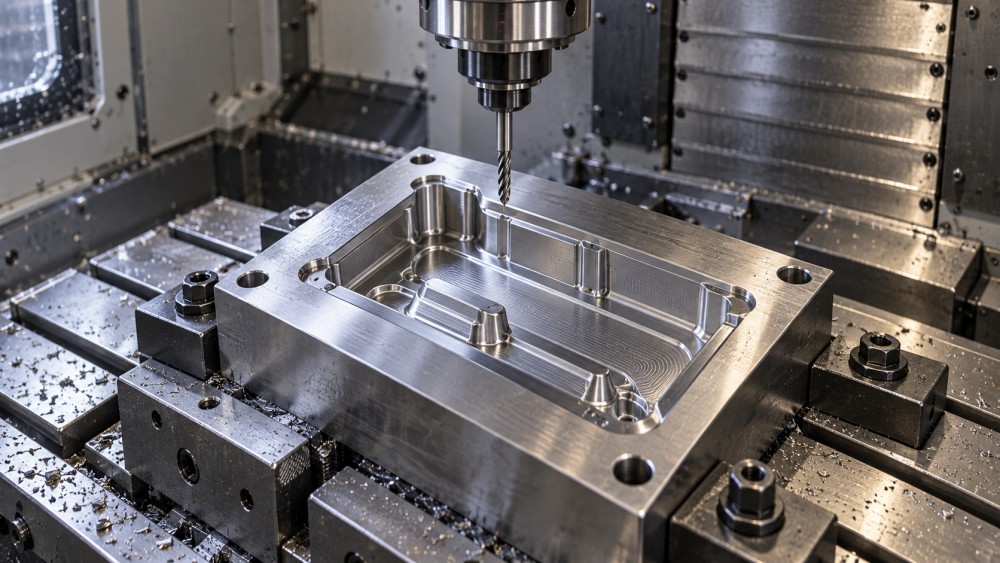
Cutting tools need physical access to every machined surface. As cavities become deeper relative to their width, cutters may need more reach and smaller diameters. These tools are more prone to deflection and vibration, so a machinist may reduce cutting loads or take additional passes to protect the tool and maintain the shape.
Small internal corner radii create a similar constraint: the tool diameter must be appropriate for the radius. A larger radius may allow a stiffer cutter and faster material removal. If a sharp internal corner is essential, the supplier may propose electrical discharge machining (EDM), a separate insert, or another process rather than CNC milling alone.
For buyers, the practical question is whether every fine feature is functional. A narrow rib that affects part strength may be non-negotiable; a tiny radius on a noncritical surface may be worth revisiting with the design team.
Undercuts and features approached from several directions
Simple cavities may be accessible from one direction. Side holes, angled surfaces, undercuts, and complex parting-line features can require the workpiece to be repositioned, additional fixtures, specialized cutters, or a multiaxis machine.
A five-axis machine can reach certain features with fewer manual setups, but it is not automatically the lowest-cost choice. Programming, machine availability, part size, and the required finish all affect the outcome. In some cases, machining a difficult area as a replaceable insert is more practical than producing the entire geometry in one piece.
Ask suppliers to identify the proposed setup strategy and any outsourced operations. This helps explain price differences and highlights handoffs that could affect delivery or dimensional consistency.
Freeform surfaces and fine detail
Curved mold surfaces often require detailed toolpaths and closely spaced finishing passes to achieve the specified geometry and surface texture. Small text, logos, textures, or intricate contours can add programming and machining time, particularly when tool changes and delicate cutters are involved.
Not every visible surface needs the same finish. A cosmetic molding surface may justify more finishing effort than a hidden or nonfunctional area. Surface requirements should therefore be specified by region, with the measurement method or acceptance standard agreed where needed. A general instruction such as “mirror finish throughout” can lead suppliers to include work that the application does not require.
Tolerances and alignment requirements
Tight tolerances increase cost because they leave less room for tool deflection, thermal variation, setup error, and material movement. The supplier may need additional finishing passes, controlled measurement conditions, more frequent checks, or a different machining sequence.
Mold components also work together. A cavity insert may be individually within tolerance yet still create fit problems if the relationship between its locating features and shutoff surfaces is not controlled. Buyers should make sure drawings identify critical datums and mating relationships, rather than applying the tightest available tolerance to every dimension.
Where precision is essential, request an inspection plan that states which features will be measured, how they will be measured, and what documentation will be supplied. Do not assume a standard inspection report covers every surface on the model.
Material, hardness, and heat-treatment sequence
Mold material affects cutting speed, tool wear, surface quality, and the choice of machining process. A pre-hardened material may reduce some downstream steps, while a material machined before hardening can require an allowance for distortion and subsequent finishing. Harder conditions may call for different cutting tools or additional grinding and EDM, depending on the feature.
The cheapest raw material is not necessarily the cheapest route to a usable mold. Procurement should compare the complete sequence: rough machining, heat treatment if specified, finish machining, any EDM or grinding, and inspection. Confirm whether the quoted material condition and hardness match the drawing and the intended mold life.
Read the quotation as a manufacturing plan
When two suppliers quote against the same model, a large price gap may reflect different assumptions rather than a simple difference in efficiency. One quote might include electrodes and polishing; another may cover milling only. One supplier may plan to inspect mating features; another may provide only a basic dimensional report.
Requesting a common scope does not require suppliers to use the same process. Different manufacturing routes can be equally valid. The goal is to compare the same deliverable and understand the implications of each approach before selecting a bid.
A practical way to reduce CNC mold machining cost
Cost reduction starts before the purchase order, when geometry and specifications can still be adjusted without disrupting production. A design-for-manufacturing review with the mold designer and prospective supplier can expose expensive details that are not obvious from a finished part drawing.
- Prioritize functional surfaces. Identify shutoffs, locating features, mating surfaces, and cosmetic areas. Apply demanding tolerances and finishes where they affect fit, sealing, appearance, or mold operation.
- Review cutter access. Consider larger internal radii, wider channels, or shallower cavities where the molded part allows them. Ask the supplier which changes would actually alter the process or tool choice.
- Consider modular inserts. A separately machined feature may simplify access or make a wear area replaceable. Balance that saving against the cost of extra interfaces, fasteners, alignment, and assembly.
- Standardize where appropriate. Common hole sizes, available cutters, and standardized mold components can reduce special tooling and planning. Confirm that standardization does not compromise the mold design.
- Share the production context. Expected molding volume, material, cosmetic requirements, maintenance expectations, and anticipated design changes help the supplier recommend a manufacturing route suited to the job.
Every proposed simplification should go back to the responsible design or tooling engineer for approval. Enlarging a radius may ease machining but change the molded part; splitting a cavity may create a witness line or introduce a maintenance issue. A lower machining quote is only a saving if the resulting mold remains fit for purpose.
Example: comparing two routes for a detailed cavity
Imagine a buyer requesting a cavity insert with deep, narrow ribs and a polished visible surface. Supplier A proposes milling the main cavity, using EDM for the rib details, and polishing the specified cosmetic region. Supplier B proposes a modular rib insert that can be machined separately and fitted into the cavity.
Neither route is inherently better. The EDM approach may avoid an additional joint but require electrodes and extra process time. The modular approach may improve access and replacement options, but its mating surfaces need machining and inspection, and the joint must be acceptable for the molded part. Before comparing totals, the buyer should ask both suppliers to describe the expected parting or witness marks, inspection coverage, assembly work, and any exclusions.
This is an illustrative comparison, not a prediction of which method will cost less. Material, tolerances, equipment, production requirements, and supplier capabilities can change the answer.
Questions to settle before awarding the order
A sound sourcing decision connects the quoted price to a clear technical scope. Before placing the order, confirm the drawing and model revision, the features that govern acceptance, the proposed manufacturing sequence, and who approves deviations or design changes. Agree on whether trial fitting, mold assembly, or molding trials are included; these are not automatically part of a CNC-machined component quote.
It is also worth discussing lead-time assumptions. A complex feature may depend on a specialized tool, an external heat-treatment provider, or an inspection resource. Knowing those dependencies early gives procurement a more realistic view of schedule risk than a single delivery date alone.
Ultimately, mold complexity affects cost wherever it increases access difficulty, process steps, precision requirements, or uncertainty. The best-value quotation is the one that makes those choices visible and delivers the required mold function—not simply the one with the lowest number at the bottom of the page.