
Industrial Fastener Technology: What Affects Lifecycle Cost Most?
Industrial fastener technology: where does lifecycle cost really come from?
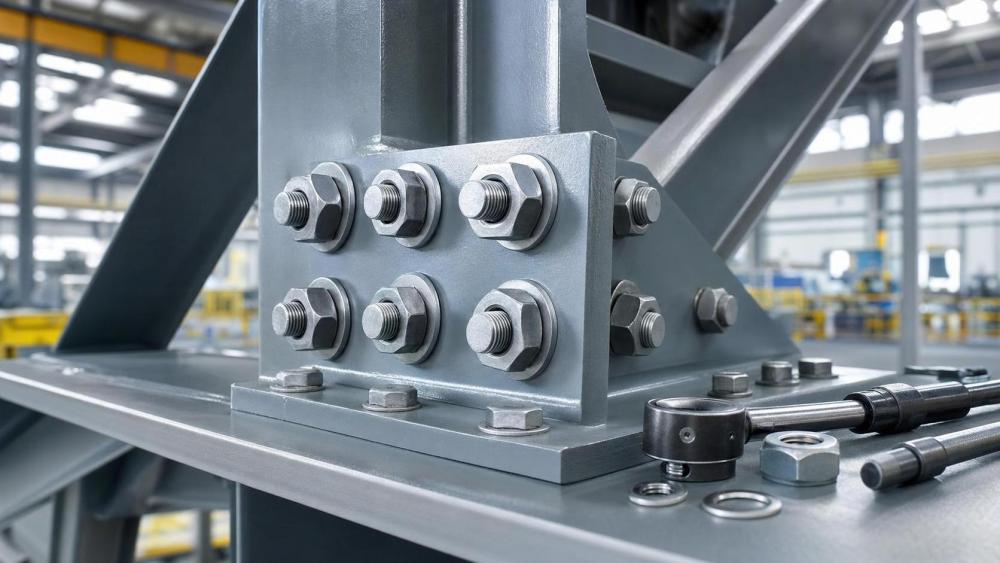
In industrial fastener technology, the largest cost driver is rarely the unit price on a quote sheet.
A low-cost bolt can become expensive after rework, corrosion damage, torque loss, downtime, or early replacement.
That is why lifecycle cost matters more than piece price, especially in heavy structures, automated assembly, and safety-critical equipment.
The practical question is not only, “How much does this fastener cost today?”
A better question is, “What will this fastening decision cost over service life, maintenance cycles, and operating risk?”
Across transport, energy, fabrication, machinery, and welded assemblies, the answer usually comes down to six variables.
Material grade, corrosion resistance, preload retention, installation control, inspection burden, and failure consequence shape total value.
HTWS often tracks these links across structural fasteners, torque tools, machining quality, and welding system reliability.
That broader view matters, because a fastener never works alone.
It works inside a joint, under a process, and within a maintenance strategy.
Is material grade the biggest lifecycle cost factor, or is that too simple?
Material grade is a major factor, but it is not the whole story.
In industrial fastener technology, grade affects tensile strength, fatigue resistance, temperature stability, and compatibility with joint design.
If the grade is too low, the joint may loosen, stretch, crack, or fail under cyclic loading.
If the grade is unnecessarily high, cost rises without meaningful service benefit.
More common lifecycle losses come from mismatched grade selection.
For example, a high-strength fastener in a corrosive outdoor structure may still fail early if coating and base material are poorly matched.
A stainless option may reduce replacement frequency, but only when galling risk and torque behavior are understood in advance.
In welded steel frames, another issue appears.
Joint stiffness, hole quality, and clamping consistency influence the fastener as much as the fastener itself.
This is where the HTWS perspective is useful.
Its coverage of machining tools, welding automation, and structural joints highlights a recurring truth: joint performance is system performance.
A stronger bolt cannot fully compensate for poor tolerances, thermal distortion, or uncontrolled tightening.
Why do corrosion and preload retention often cost more than the fastener itself?
Because these are the silent cost multipliers.
Corrosion does not only shorten service life.
It also increases inspection frequency, removal difficulty, surrounding component damage, and unplanned shutdown risk.
Preload loss creates a similar problem.
When clamp force drops, vibration, fretting, leakage, and fatigue damage usually follow.
The replacement cost of one loose joint may be small.
The cost of line stoppage, field service, or structural risk is not.
This is especially important in wind towers, rail assemblies, offshore structures, process skids, and robotic production fixtures.
In such cases, industrial fastener technology must be evaluated against actual exposure.
Humidity, salt spray, heat cycling, chemical contact, and high-frequency vibration all change lifecycle economics.
A coating that looks cost-effective in storage may perform poorly in service.
Likewise, a locking feature that works on paper may lose effectiveness after repeated maintenance access.
That is why buyers increasingly compare not just finish type, but torque retention behavior over time.
This table also explains why the cheapest offer is often the least predictable option.
What should be checked before comparing suppliers on price?
Price comparison only works when the technical baseline is controlled.
Without that, quotes may look comparable while lifecycle exposure is completely different.
A useful comparison starts with the joint, not the catalog page.
- Confirm load type: static, dynamic, impact, or thermal cycling.
- Check environment: indoor dry, marine, chemical, or high-temperature exposure.
- Review installation method: manual torque, pneumatic tools, or smart traceable tightening.
- Match coating, lubrication, and torque-tension behavior.
- Verify standards, lot traceability, and consistency across batches.
- Assess service access, inspection intervals, and replacement difficulty.
In actual sourcing work, installation consistency is often underestimated.
A technically sound fastener can still create high lifecycle cost if torque delivery is unstable.
This is why industrial fastener technology increasingly overlaps with digital tightening tools and process traceability.
HTWS follows this convergence closely across power tools, fastening systems, and structural assembly trends.
The value is practical.
Better torque control reduces scatter, and lower scatter reduces hidden cost.
When does a premium fastener actually save money?
Not in every case.
A premium option creates value when failure cost is high, access is difficult, or process stability matters more than unit cost.
That usually applies in remote assets, high-vibration equipment, outdoor infrastructure, and safety-critical frames.
It also applies where maintenance shutdowns are expensive.
For example, if a corrosion-resistant fastener doubles service life and avoids one field intervention, the premium may be minor.
If a locking design reduces retightening frequency on vibrating equipment, labor savings may outweigh price differences quickly.
The same logic appears in high-end manufacturing cells.
A stable joint supports repeatable accuracy in welded fixtures, machined assemblies, and automated tool stations.
In that setting, industrial fastener technology influences not only durability, but process capability.
Premium does not mean buying the strongest or most exotic part available.
It means paying for the performance characteristic that eliminates the most expensive failure mode.
Which mistakes usually inflate lifecycle cost after the order is placed?
Several mistakes appear again and again, even in mature supply chains.
One common error is treating standards compliance as proof of application fit.
A compliant fastener can still be wrong for vibration, coating compatibility, or service temperature.
Another mistake is ignoring the full joint stack.
Washers, hole quality, surface condition, and clamped material behavior all affect preload retention.
There is also a process mistake.
Teams may approve a part without validating real tightening performance under production conditions.
That can lead to torque scatter, galling, under-clamping, or overtightening damage.
A short validation checklist can prevent most of this:
- Run torque-tension trials with the actual coating and lubricant condition.
- Test loosening resistance under realistic vibration or thermal cycling.
- Review whether removal and reinstallation are expected in service.
- Check if traceability is needed for audits, warranty, or critical infrastructure.
- Estimate the cost of access before approving a “replace more often” strategy.
These steps are simple, but they shift industrial fastener technology decisions from reactive buying to controlled lifecycle planning.
So what is the smartest way to judge lifecycle cost before buying?
A smart judgment combines technical fit, process control, and consequence of failure.
In other words, calculate value where the joint actually lives, not where the part is stored.
Start by identifying the dominant risk.
Is it corrosion, loosening, fatigue, difficult maintenance access, or inconsistent installation?
Then compare fastener options against that risk first, and unit price second.
For many applications, the biggest lifecycle savings come from avoiding one bad event.
That event might be a shutdown, a retorque campaign, a seized removal, or a field failure.
Industrial fastener technology should therefore be reviewed alongside tightening tools, assembly quality, and structural context.
That cross-process view is increasingly important in modern manufacturing, where welding, machining, fastening, and automation are tightly connected.
A practical next step is to build a short comparison sheet for each critical joint.
Include operating environment, clamp force target, coating system, installation method, maintenance interval, and failure consequence.
That approach makes supplier comparisons clearer and helps reveal which option protects total cost over time.
In most cases, lifecycle cost falls fastest when the fastener, the joint, and the assembly process are evaluated together.