
Metal Connection Cost Analysis: What Drives Total Installed Cost?
Metal Connection Cost Analysis: What Drives Total Installed Cost?
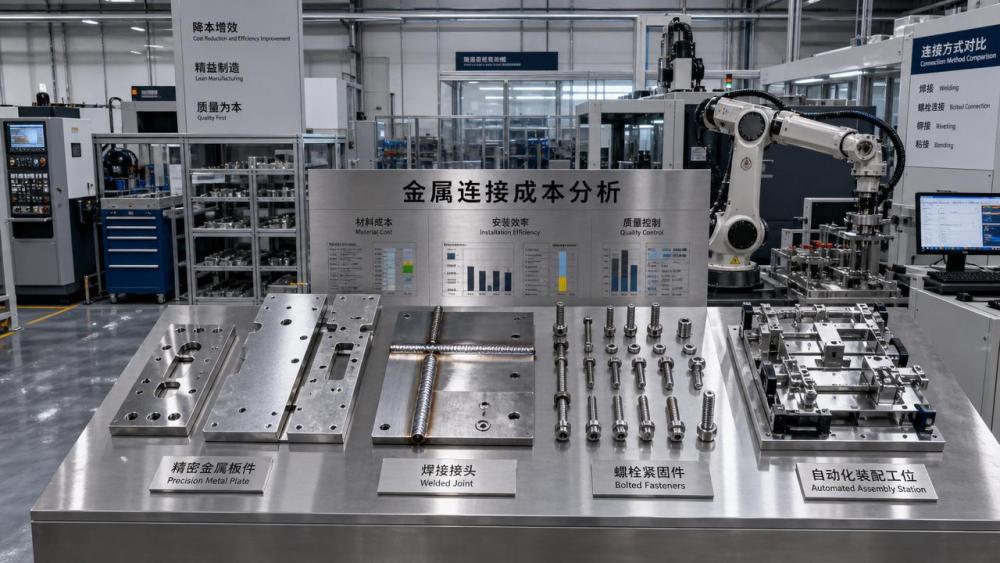
For finance approvers, metal connection cost analysis starts with a simple question.
What will this joint really cost after installation, downtime, rework, and service risk are counted?
That question matters because the lowest unit price rarely creates the lowest total installed cost.
A cheaper fastener may increase assembly time.
A low-cost weld process may raise scrap, energy use, or operator dependency.
In practical purchasing, metal connection cost analysis must compare complete system economics, not isolated line items.
That includes labor, equipment depreciation, tooling wear, throughput, training, inspection, and field reliability.
Once those factors are visible, approval decisions become far more defensible.
Why Unit Price Misleads Metal Joining Decisions
Many teams still compare connections by material cost alone.
That shortcut creates blind spots in metal connection cost analysis.
A weld bead, rivet, bolt, insert, or adhesive-assisted joint may look inexpensive on paper.
Yet installation conditions often drive the actual economics.
For example, a robotic arc cell can carry higher capital cost.
But it may lower labor dependence, cut variation, and stabilize output over several shifts.
Likewise, handheld laser welding can reduce finishing time on thin materials.
That changes installed cost even when equipment pricing seems higher at first glance.
The better signal is cost per accepted assembly, not cost per component.
The Core Cost Drivers Behind Total Installed Cost
A reliable metal connection cost analysis usually breaks into six drivers.
- Connection material cost, including filler wire, fasteners, shielding gas, and consumables.
- Installation labor, including setup, fit-up, handling, and finishing.
- Equipment cost, spread across useful life, utilization, and maintenance hours.
- Cycle time, because every extra second affects throughput and backlog.
- Quality cost, including rework, scrap, inspection, and warranty exposure.
- Lifecycle risk, such as loosening, fatigue failure, corrosion, or joint deformation.
These categories look familiar, but their weight changes by process.
A bolt-on design may simplify service and reduce field downtime.
A welded design may improve stiffness and remove secondary hardware.
The right answer depends on which costs dominate the application.
1. Labor Often Outweighs Material Savings
Labor is often the fastest hidden cost in metal connection cost analysis.
If a joining method needs edge preparation, clamping, repositioning, or post-grind finishing, costs rise quickly.
This is especially true in mixed-volume production.
Small handling delays repeat thousands of times each month.
Recent market changes make this even more visible.
Skilled welding labor remains difficult to secure in many regions.
That means process choices with lower skill dependency can protect margins.
2. Equipment Cost Must Be Linked to Utilization
Capital spending should never be reviewed in isolation.
In metal connection cost analysis, equipment economics depend on how often the asset actually runs.
A premium laser welding system looks expensive at low utilization.
At high utilization, the same system may lower cost per joint through speed and consistency.
The same logic applies to robotic arc cells, torque tools, feeders, and positioning systems.
Approval decisions improve when utilization scenarios are modeled conservatively.
3. Cycle Time Is a Financial Variable
Cycle time is not just an operations metric.
It is a direct financial lever in metal connection cost analysis.
Faster joining reduces labor hours, line congestion, and work-in-process.
It may also delay new line expansion.
This is where handheld laser systems, pre-fed fastener tools, and integrated fixturing can outperform slower traditional steps.
A process that saves twelve seconds per assembly can create a very large annual gain.
Hidden Costs That Commonly Distort Metal Connection Cost Analysis
The most expensive costs are often the least visible at sourcing stage.
That is why many cost models understate total installed cost.
Several hidden items deserve close review before approval.
- Training time for operators, programmers, and inspectors.
- Quality documentation required by regulated industries.
- Fixture design changes needed for a new joining method.
- Ventilation, safety shielding, and compliance upgrades.
- Surface finishing after heat input or spatter generation.
- Service calls caused by vibration loosening or fatigue cracks.
These items rarely appear in first-round quotations.
Yet they strongly influence metal joining cost over time.
A realistic metal connection cost analysis should assign values to each one.
Quality Loss Is More Expensive Than It Looks
Rejects do more than waste material.
They consume labor, machine time, inspection time, and delivery credibility.
If a process produces variable penetration or inconsistent torque retention, costs multiply quietly.
This is a major reason HTWS tracks welding automation, fastening integrity, and tool durability together.
The connection method is only part of the story.
Process stability around that method often decides the real outcome.
A Practical Cost Comparison Framework
A useful metal connection cost analysis should be simple enough to apply quickly.
At the same time, it must capture more than purchase price.
This framework helps standardize internal reviews.
It also prevents vendors from steering discussion toward a single favorable metric.
Questions to Ask Before Approving a Joining Investment
Good procurement decisions usually come from better questions.
Before final approval, a metal connection cost analysis should challenge assumptions clearly.
- What is the cost per accepted assembly at expected production volume?
- How sensitive is the process to operator skill and material variation?
- What rework rate was measured in comparable production conditions?
- Which maintenance items are predictable, and which are disruptive?
- How easily can the joint be inspected, repaired, or replaced in service?
- What happens to cost if utilization drops below plan?
These questions move the conversation from price to economics.
That shift usually leads to stronger long-term ROI decisions.
Final Takeaway on Metal Connection Cost Analysis
The best metal connection cost analysis does not chase the cheapest joining method.
It identifies the option with the strongest installed value across production and service life.
That means balancing direct price with labor, throughput, equipment burden, quality stability, and downstream risk.
In real operations, the winning process is often the one that looks more expensive at first.
But once hidden costs are exposed, the business case becomes clearer.
Use metal connection cost analysis as a decision filter, not a pricing checklist.
That approach supports more confident approvals, better cost control, and stronger return over the full life of every joint.