
Powder Metallurgy in 2026: Cost Benefits and Design Limits
Powder Metallurgy enters 2026 with unusual momentum. Cost pressure, unstable alloy sourcing, and demand for tighter process control are pushing it back into boardroom discussions.
The appeal is easy to see. Powder Metallurgy can reduce scrap, shorten machining time, and deliver repeatable shapes at scale, especially in tooling, fasteners, and wear parts.
Yet the process is not a universal substitute for forged, cast, or fully machined components. Its value depends on geometry, density targets, loading conditions, and downstream finishing needs.
For industrial intelligence platforms such as HTWS, this makes Powder Metallurgy more than a materials topic. It sits at the intersection of cutting performance, joining reliability, and manufacturing economics.
Why Powder Metallurgy is drawing renewed attention
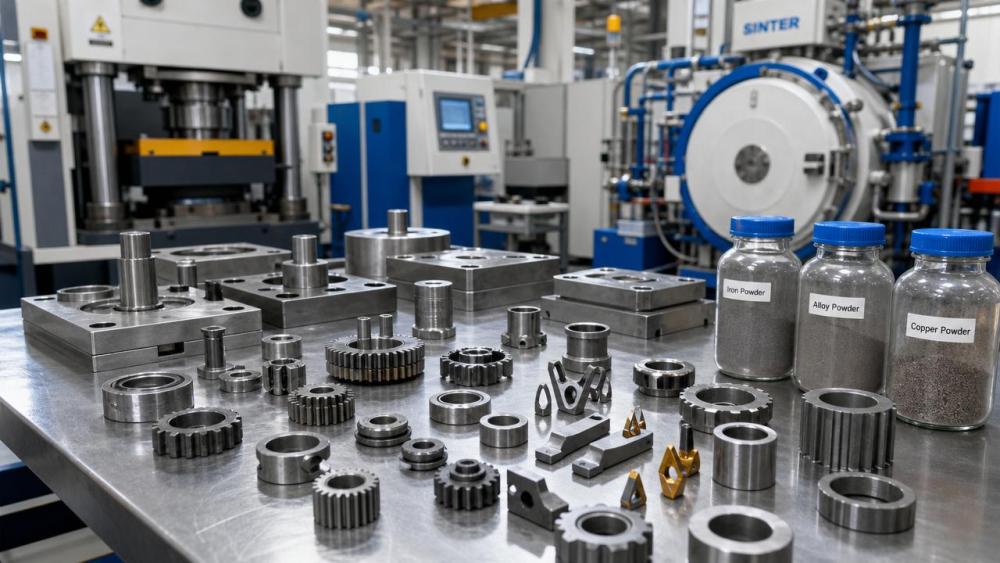
In simple terms, Powder Metallurgy forms parts from metal powders through compaction and sintering. Depending on the route, sizing, impregnation, heat treatment, or secondary machining may follow.
That basic sequence is familiar. What changes in 2026 is the economic context around it.
Raw material volatility has made yield loss far more expensive. Powder Metallurgy often uses feedstock more efficiently than subtractive methods, which matters when alloy prices move quickly.
Labor availability also matters. Near-net-shape production reduces touchpoints, helping operations control cost without adding as much manual finishing.
Another driver is consistency. In sectors tied to cutting tools, power tools, and structural fastening, stable dimensions and predictable wear behavior often matter more than theoretical material maximums.
HTWS closely tracks these connections because Powder Metallurgy affects several adjacent systems. It influences insert performance, torque transfer parts, sintered gears, bushings, and some structural hardware categories.
Where the cost benefits are real
The strongest business case usually appears when design volume, shape repeatability, and material utilization line up at the same time.
Powder Metallurgy is often most competitive in the following situations:
- Medium to high production volumes that justify dedicated tooling.
- Parts needing controlled porosity, self-lubrication, or tailored friction behavior.
- Geometries that would create heavy scrap in bar-stock machining.
- Components requiring stable weight and repeatable dimensions across large batches.
- Applications where secondary machining can be limited to critical surfaces only.
This is why Powder Metallurgy remains highly relevant to high-precision CNC tools. Carbide grades, wear-resistant inserts, and related tool materials depend on powder-based routes for microstructure control.
The same logic extends to industrial fasteners and tool-drive components. If the part family is stable and annual volume is predictable, cost per unit can become very attractive.
However, savings should be measured across the whole chain, not only at pressing or sintering stage. Tooling amortization, furnace energy, atmosphere control, and finishing can reshape the equation.
A practical comparison framework
Design limits that still shape the decision
Powder Metallurgy performs best when the design respects the process. Many disappointments come from trying to force a forged-part mindset into a sintered-part route.
Density remains one of the central issues. Lower or uneven density can affect fatigue strength, impact behavior, and sealing performance.
This becomes especially important in dynamic loads, high-vibration assemblies, or safety-critical joints. Fasteners for severe structural duty often require careful validation before Powder Metallurgy is accepted.
Geometry also matters. Thin walls, sharp transitions, cross-holes, and lateral features can complicate pressing or create weakness after sintering.
Tolerance assumptions deserve equal attention. Powder Metallurgy can be precise, but not every feature should be expected to match ground or fine-machined performance without secondary operations.
Material choice is another boundary. Some alloys are highly mature in Powder Metallurgy. Others remain costly, difficult to densify, or unsuitable for the target property set.
Questions that reveal hidden risk
- Is the part loaded in compression, bending, or cyclic tension?
- Does the design depend on full density in local critical zones?
- Can the geometry be simplified for axial pressing?
- Will machining, coating, or heat treatment erase the expected savings?
- Are inspection methods prepared to track density-related variation?
How Powder Metallurgy connects to broader industrial systems
Powder Metallurgy rarely operates in isolation. Its value shows up inside larger manufacturing systems that HTWS follows closely.
In cutting tools, powder routes support hard materials, fine grain structures, and wear resistance. That directly affects machining productivity and tool-change intervals.
In power and pneumatic tools, sintered gears and structural drive parts may improve cost control while maintaining repeatability in torque transmission components.
In welding automation, fixture elements, wear parts, and some feeding-system components may benefit from Powder Metallurgy when replacement rates are high and geometry is stable.
In fastening systems, the relevance is more selective. Powder Metallurgy can serve specialized hardware well, but highly loaded structural connections still demand careful comparison against forged or machined alternatives.
That broader view matters because part economics are often decided by system behavior. A cheaper part that shortens tool life, reduces joint reliability, or complicates inspection is not truly lower cost.
What a sound 2026 evaluation should include
A useful Powder Metallurgy review should move beyond headline unit price. The more reliable approach is to compare functional cost, not just quoted cost.
That means checking the full commercial and technical picture:
- Tooling investment versus expected annual volume and part family stability.
- Density targets, mechanical property ranges, and process capability data.
- Secondary operations, including sizing, machining, grinding, or impregnation.
- Supply risk for metal powders, alloy elements, and furnace consumables.
- Lifecycle effects on wear, service intervals, and field failure exposure.
It is also worth asking whether a design is truly optimized for Powder Metallurgy, or simply converted from another process with minimal changes.
That distinction often decides whether the project captures real savings. A redesigned part can unlock the process. A poorly adapted part can consume those gains quickly.
Signals worth monitoring
By 2026, three signals deserve close attention. First, powder pricing and alloy availability will continue to influence competitiveness.
Second, demand for high-performance cutting materials will keep Powder Metallurgy central to advanced tooling strategies.
Third, quality assurance expectations are rising. Traceability, process data, and property validation are becoming part of the commercial decision, not an afterthought.
A balanced way forward
Powder Metallurgy deserves serious attention in 2026 because it can combine cost efficiency with strong repeatability. In the right part family, that combination is difficult to ignore.
Still, design limits remain decisive. Density, geometry, fatigue demand, and finishing needs should be treated as commercial issues as much as engineering ones.
A practical next step is to sort candidate parts into three groups: clearly suitable, clearly unsuitable, and worth redesigning. That simple screening usually sharpens the investment case quickly.
From there, compare lifecycle cost, qualification effort, and supply resilience side by side. That approach turns Powder Metallurgy from a broad idea into a disciplined 2026 decision framework.