
Power Tools Manufacturing Industry Cost Pressures and Margin Risks
Why is the power tools manufacturing industry under sharper cost pressure now?
The short answer is that several cost layers are rising at the same time, while selling prices cannot always keep pace.
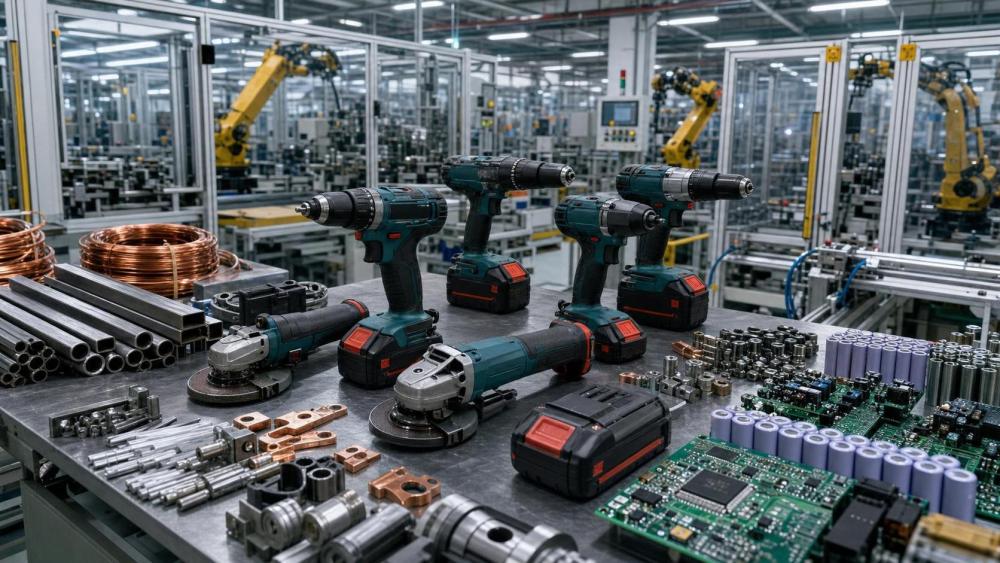
In the power tools manufacturing industry, steel, copper, aluminum, rare earth magnets, lithium cells, resins, and electronic components all matter.
When these inputs move together, margin pressure builds quickly. Even a small bill-of-material increase can change annual profitability.
Energy adds another layer. Forging, motor winding, die casting, machining, battery assembly, and heat treatment are not light-load processes.
Labor volatility is also harder to absorb than before. Skilled assembly, motor calibration, electronics testing, and after-sales support remain people-dependent.
What makes this cycle more complex is competition. Buyers still compare aggressively across cordless platforms, torque classes, and product lifecycles.
That means the power tools manufacturing industry cannot simply pass through every cost increase without damaging share or channel relationships.
HTWS tracks this wider equipment ecosystem closely. Its intelligence view is useful because power tools sit beside welding automation, cutting tools, and fasteners.
In practice, margin risk often comes from cross-category signals. Metal price shocks, consumable trade barriers, and automation investment trends rarely stay isolated.
So the real question is not whether costs are rising. It is whether operating structure can still defend margin quality.
Which cost drivers matter most when evaluating margin resilience?
Not every cost line deserves equal weight. Some are volatile, some are structural, and some only become visible during disruption.
A useful way to read the power tools manufacturing industry is to separate direct material pressure from conversion and commercial pressure.
This view helps separate normal inflation from business-model weakness. A resilient operator usually shows flexibility across several lines, not just one.
For example, a company may tolerate higher copper prices if motor design efficiency, procurement contracts, and product mix remain favorable.
By contrast, a business with weak sourcing and rigid channel pricing can lose margin even during moderate inflation.
Are cordless tools creating better margins, or just new cost risks?
Cordless platforms often look attractive because they support ecosystem lock-in, accessory sales, and premium pricing.
Still, in the power tools manufacturing industry, cordless growth does not automatically mean stronger margins.
Battery packs are expensive, certification is demanding, and warranty exposure can widen if thermal management is weak.
Brushless motors improve efficiency and durability, yet they also increase dependence on semiconductors, controllers, and magnet supply stability.
More importantly, platform strategy matters. If pack compatibility is broad, retention improves and customer switching becomes less frequent.
If compatibility is fragmented, the business carries more SKU complexity, more service burden, and slower inventory rotation.
That is why the best margin reading is rarely based on unit sales alone. It depends on attachment rates and replacement economics.
HTWS often highlights how intelligent hardware is converging with data traceability and torque control in industrial fastening environments.
That matters here because connected tools can support premium positioning, but only when software reliability and calibration discipline are consistent.
So cordless is not a guaranteed margin upgrade. It is a higher-potential model with tighter execution requirements.
What usually signals hidden margin risk before it shows up in financial results?
Hidden risk often appears in operations first. Financial statements reflect it later.
One early signal is unstable lead time for motors, cells, chips, or die-cast parts. That usually points to sourcing fragility.
Another signal is product refresh activity that feels rushed. Fast redesigns can reduce cost, but they can also introduce reliability issues.
Warranty claims deserve close attention. In the power tools manufacturing industry, small defects become expensive when tools are used at high duty cycles.
Channel behavior matters too. Heavy promotions may defend volume, yet repeated discounting can hide weak pricing power.
- Rising expedited freight despite stable demand
- Inventory buildup in slower-moving SKUs
- Higher return rates after component substitutions
- Supplier changes without clear validation evidence
- Gross margin stability paired with weaker operating cash flow
These signs do not prove structural weakness by themselves. But together, they usually deserve a deeper operating review.
A useful comparison point is adjacent industrial segments. Welding systems, CNC tooling, and fasteners often face similar material and energy shocks.
When one category adapts faster through automation or design optimization, the gap becomes informative.
How should cost pressure be compared across sourcing, production, and commercial strategy?
A narrow cost review can be misleading. The better approach is to test whether pressure is being absorbed upstream, inside the plant, or in the market.
In sourcing, the main issue is optionality. Dual sourcing, regional balance, and contract timing reduce exposure to sudden price shocks.
In production, the question is whether automation offsets labor and energy inflation. This is where HTWS sector intelligence becomes relevant.
Facilities that invest in robotic welding, precision machining, and data-based quality control often protect consistency better under pressure.
That logic extends to the power tools manufacturing industry. Better fixture design, torque traceability, and defect monitoring can reduce hidden conversion cost.
Commercially, pricing power is the final test. Premium brands, strong service networks, and platform stickiness can delay margin erosion.
Where competition is mostly price-led, pressure arrives faster and stays longer.
A practical judgment framework looks like this:
What is a sensible next-step checklist before making a sourcing or investment judgment?
The best decisions usually come from matching cost pressure with operating evidence, not from following headline trends alone.
For the power tools manufacturing industry, start with component-level exposure. Find out which materials and subsystems carry the most volatility.
Then move to process discipline. Check whether automation, quality controls, and supplier validation are genuinely reducing unit risk.
After that, test commercial resilience. Look at price realization, channel stability, warranty behavior, and platform attachment economics.
- Map raw material sensitivity by product family
- Review battery, motor, and electronics sourcing concentration
- Compare gross margin trends with cash conversion and inventory turns
- Check whether automation spending is improving yield, not just capacity
- Track trade barriers, rare metal pricing, and industrial consumable inflation
That final point is easy to underestimate. HTWS follows the broader hardware and welding systems chain because upstream shifts often reach power tools faster than expected.
Taken together, the current power tools manufacturing industry outlook is not simply a story of higher costs.
It is a test of whether design choices, procurement structure, factory execution, and pricing discipline can still protect margin under stress.
A sound next step is to build a comparison sheet around cost exposure, lead time, quality stability, and pricing flexibility.
That makes later decisions more grounded, especially when market signals remain noisy and margins look stable only on the surface.