
When do assembly line solutions justify automation investment?
A production line can appear busy while still losing money through waiting, rework, inconsistent cycle times, and skilled operators spending hours on repetitive handling. This is often the point at which leaders begin evaluating assembly line solutions: not because automation is fashionable, but because a bottleneck is becoming a constraint on delivery, margin, quality, or workforce stability.
Automation investment is justified when the constraint is measurable and persistent, the process is stable enough to automate, and the expected lifecycle benefit exceeds the full cost of owning the system. That benefit is not limited to labor reduction. It may come from higher throughput, lower variation, safer material handling, traceable fastening, more predictable welding quality, reduced scrap, or the ability to run additional shifts without relying on scarce specialized labor. A machine that replaces a task but creates new downtime, programming, or changeover problems is not necessarily a sound investment.
Start with the constraint, not the equipment
The wrong starting question is often, “Which robot should we buy?” The better question is, “What prevents this line from producing acceptable units at the required rate?” A robotic welding cell, automatic screwdriving station, conveyor system, or vision-guided handling unit should be considered only after the actual constraint has been identified.
In a typical assembly environment, the visible bottleneck may be an operator station where parts queue up. Yet the underlying cause can be elsewhere: components arrive inconsistently, fixtures require repeated adjustment, fasteners are missing, weld fit-up varies, or downstream inspection rejects work that appeared complete. Automating the crowded station without correcting these conditions can simply move the queue to a different point in the line.
Before requesting quotations for assembly line solutions, map one representative production flow from incoming component to completed unit. Record where work waits, where operators intervene, where defects are detected, and where a station runs slower than the intended takt time. The purpose is not to produce a perfect process study. It is to determine whether the limitation is repetitive physical work, process instability, material flow, engineering variation, or capacity planning.
- Repetitive manual work: Parts are loaded, positioned, tightened, welded, labeled, or transferred in the same sequence for most units.
- Quality variation: Torque, weld position, bead consistency, orientation, or component presence changes between operators or shifts.
- Labor availability: Required skills are difficult to staff, absenteeism disrupts output, or training time is long.
- Safety exposure: Heat, fumes, awkward reaches, sharp edges, heavy parts, vibration, or high reaction torque create recurring risk.
- Capacity pressure: The current method cannot reliably meet demand without overtime, additional floor space, or a second manual station.
A clear pattern across several of these areas is more meaningful than one isolated complaint about labor cost. Automation is strongest when it removes a recurring limitation from a process that already has a defined operating method.
When the economics are real rather than assumed
Capital approval should be based on a lifecycle comparison between the current process and the proposed future process. The purchase price is only one part of that comparison. A lower-cost cell may require more operator attention, spare parts, maintenance time, custom fixtures, or engineering support than expected. A more capable system may be difficult to justify if its capacity will remain unused for much of its life.
Estimate the current cost using the work actually required to produce an acceptable unit. Include direct labor at the constrained process, inspection or rework caused by variation, consumables, overtime, downtime caused by manual fatigue or shortages, and the cost of missed output when the station cannot keep pace. Then estimate the future cost with realistic assumptions for loading, supervision, planned maintenance, programming, commissioning, tooling replacement, utilities, and operator training.
Do not treat every saved manual minute as a cash saving. If staff will be reassigned to another required operation, the financial benefit may come from avoided hiring, improved output, or reduced overtime rather than a reduction in headcount. That can still justify investment, but the business case should state the mechanism accurately.
The financial model should include a sensitivity view. Test what happens if volume is lower than planned, if uptime takes longer to stabilize, or if changeovers occur more often than expected. An investment that works only under perfect utilization is fragile. A sound project usually retains value because it addresses a real operational constraint even when demand or labor assumptions shift.
Separate automation-ready work from work that needs redesign
Not every manual task should be automated in its current form. A process may be highly repetitive but still unsuitable because the product is poorly located, components arrive with large dimensional variation, or the work sequence changes frequently. In those situations, better fixtures, part presentation, engineering standardization, or error-proofing may provide a faster return than a full automated cell.
Welding is a useful example. Robotic arc welding can provide highly consistent motion and repeatable parameters, but it does not remove the need for reliable joint fit-up. Where weld gaps, part distortion, or tack quality vary widely, the robot may spend time recovering from conditions that an experienced welder can visually compensate for. Seam tracking and vision can widen the operating window, but they should not be used as a substitute for basic fixture and component control.
The same principle applies to automated fastening. A smart electric or pneumatic tool can record torque and angle, confirm completion, and reduce variation. However, it cannot correct cross-threaded starts caused by poor access, damaged threads, or misaligned components. If operators regularly reposition parts before driving a fastener, the first investment may need to be a locating feature or fixture rather than a multi-spindle fastening station.
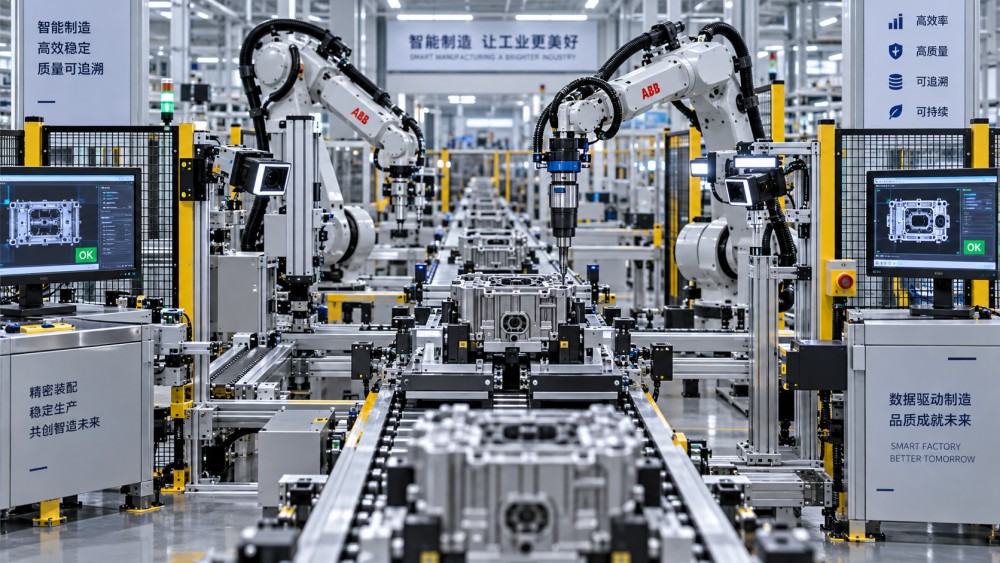
Assess the work content at the level of individual motions. Ask whether the part can be presented in a known orientation, whether a fixture can define the critical datum points, whether the tool can reach every required location, and whether acceptance can be measured automatically or through a clear downstream check. A positive answer to these questions does not guarantee success, but repeated uncertainty points to a process-design project rather than an automation purchase.
Choose the level of automation that fits product variety
“Automation” is not a single decision. The appropriate level depends heavily on volume, mix, part weight, product maturity, and the cost of changing over. A fully integrated transfer line may be effective for stable, high-volume products with predictable sequences. It can become a liability when product configurations change regularly or when demand is distributed across many low-volume variants.
Manual workstations with controlled tools
This is often the practical first step where volume is moderate, product mix is high, or the assembly sequence still changes. Digital torque tools, guided work instructions, barcode validation, poka-yoke fixtures, lift assists, and simple conveyors can improve repeatability without removing operator judgment. They also generate useful process data before a larger capital decision.
Semi-automated cells
Semi-automation is appropriate when the operator’s role is still valuable for loading, visual assessment, or variant selection, while the machine performs the critical repeatable action. Examples include a fixture that automatically clamps and tests a part, a programmed fastening station, a cobot-assisted material-handling operation, or a weld positioner that improves access and consistency. This approach can reduce risk because the system is focused on the most constrained portion of the cycle.
Dedicated robotic or automated lines
Higher levels of automation make sense when the product and process are mature, required output is sustained, and deviations can be detected or recovered in a controlled way. Robotic welding workstations, automated cutting and feeding systems, palletized assembly lines, and integrated inspection stations can deliver strong value where repeatability is central to product quality. Their justification depends on reliable utilization, not on an attractive theoretical cycle time.
A modular design is often preferable when the future product mix is uncertain. Independent stations with defined handoff points may permit capacity to be added or modified without rebuilding the entire line. This can cost more than a tightly optimized dedicated layout, but it may reduce the commercial risk of committing to a single product configuration.
Verify cycle time in the real operating sequence
Vendor demonstrations and simulation outputs are useful, but procurement decisions should examine the complete cycle. A robot may execute a weld path or screwdriving pattern quickly, while the actual station loses time to part loading, clamp confirmation, tool changes, barcode reads, part orientation, discharge, inspection, and fault recovery. Those activities determine whether the line meets output requirements.
Use the planned takt time as the reference point. Then test whether the proposed station can achieve it while accommodating normal variation. The question is not whether it can complete one ideal cycle. It is whether it can complete repeated production cycles without creating a queue, requiring constant intervention, or compromising quality.
Ask suppliers and internal engineering teams to make assumptions visible. Which tasks remain manual? How are incorrect parts detected? What happens after a missed fastener, a failed torque result, an incomplete weld, or a sensor fault? How long does a product variant changeover take? Which components are considered wear items? A proposal that answers these questions clearly is easier to compare than one that presents only headline throughput.
Plan for uptime before approving the layout
Automation changes the nature of operational risk. A manual process may degrade gradually as staffing or fatigue becomes an issue. An automated station can stop abruptly because of a sensor, feeder, clamp, communication, or tooling problem. This does not make automation less valuable, but it means availability must be designed into the project.
Equipment access matters. Maintenance staff need room to inspect cables, replace consumables, clean sensors, service tooling, and recover a stopped part safely. Fixtures should allow wear components to be changed without excessive realignment. Critical spare parts should be identified during procurement, especially items with uncertain lead times. For welding cells, consumable management, torch cleaning, wire feeding, fume extraction, and fixture condition deserve the same attention as robot programming.
Clear ownership is equally important. Production personnel need defined restart procedures; quality teams need to know how traceability data will be reviewed; maintenance teams need training and documentation; engineering needs control over program and parameter changes. Without these responsibilities, a technically capable system can become dependent on a small number of individuals, undermining the resilience the investment was intended to create.
Use a staged decision when uncertainty remains
When the operational need is clear but process inputs remain uncertain, a staged project can be more defensible than either immediate full automation or indefinite delay. The first stage may standardize tooling, improve fixturing, introduce traceable power tools, or install a semi-automated station at the constraint. The resulting operating data can clarify actual cycle time, variation, maintenance demand, and volume stability.
This approach is especially useful for manufacturers introducing new assemblies or working with multiple variants. It prevents a permanent line from being designed around assumptions that have not yet been proven on the shop floor. It also reveals whether the strongest return lies in handling, joining, fastening, inspection, or material supply rather than in the most visible manual task.
Automation investment becomes credible when it is tied to a defined constraint, a controlled process, a complete operating-cost model, and a support plan for the equipment after installation. Where those conditions are absent, the right decision may be to improve the process first. Where they are present, assembly line solutions can convert labor-dependent output into a more repeatable, traceable, and scalable production capability without treating capital equipment as a substitute for sound manufacturing discipline.