
Industrial Tooling Technology Trends Shaping Output in 2026
Industrial Tooling Technology Is Moving From Equipment Choice to Output Strategy
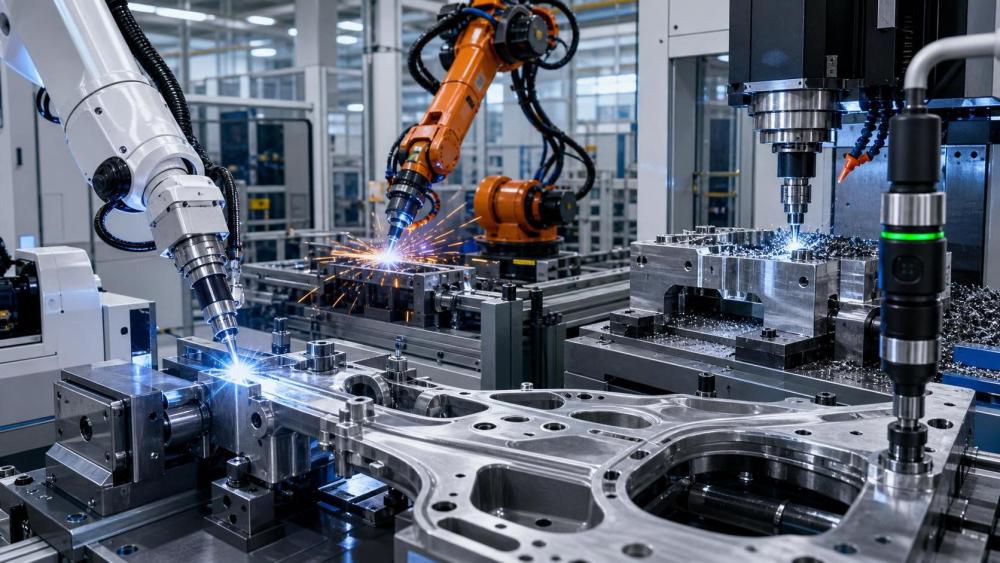
Industrial Tooling Technology is no longer a narrow engineering topic in 2026. It now shapes throughput, traceability, and margin protection across modern manufacturing networks.
What changed is not only machine capability. The bigger shift is that cutting, welding, fastening, and torque control are being evaluated as connected output systems.
That is especially visible in sectors balancing volume pressure with stricter quality thresholds. A faster line has little value if rework, tool wear, or joint instability rises with it.
Recent market signals point in the same direction. Industrial Laser Welding Machines, robotic arc cells, precision CNC tools, smart power tools, and high-strength fasteners are advancing together.
This convergence matters because production performance now depends on the integrity of every cut edge, weld seam, torque event, and structural connection across the full lifecycle.
For HTWS, this has become the center of observation. The platform’s focus on welding automation, machining tools, power systems, and structural fasteners reflects where output gains are actually being won.
The Strongest Signal in 2026 Is Integration Across the Tooling Stack
A few years ago, many plants still upgraded one station at a time. In 2026, Industrial Tooling Technology investment is increasingly made around process continuity rather than isolated assets.
Handheld laser welding is a good example. It lowers entry barriers, but its real effect appears when upstream edge preparation and downstream inspection also improve.
The same pattern is visible in robotic arc welding. Seam tracking, positioners, and power source intelligence now matter as much as the robot arm itself.
On the machining side, precision tooling is being judged less by catalog specifications and more by stable performance under heat, vibration, and difficult alloys.
Even fastening has changed category. Fasteners and torque tools are becoming data-bearing quality checkpoints, not simple consumables placed at the end of assembly.
This is why Industrial Tooling Technology now influences output strategy at plant level. It determines how smoothly material transformation becomes finished, certifiable production.
Where the shift is becoming easiest to see
- Welding cells are moving toward adaptive control instead of fixed parameter windows.
- CNC cutting tools are selected for wear predictability, not only peak cutting speed.
- Cordless and pneumatic tools are being tied to torque traceability systems.
- Fastener decisions are increasingly linked to vibration life and structural risk models.
Why These Industrial Tooling Technology Trends Are Accelerating Now
The timing is not accidental. Several pressures have aligned, making older tooling logic too slow, too opaque, or too costly to defend.
Labor dynamics are one driver. Easier-to-deploy laser systems and more intuitive automated cells help reduce dependence on scarce specialist skills.
Material complexity is another. Ultra-thin sheets, dissimilar metals, titanium, and superalloys punish inconsistent energy delivery and weak tool life control.
A third factor is documentation pressure. International tenders and regulated industries increasingly ask for proof, not assumptions, around process capability and joint reliability.
Supply chain volatility also matters. Rare metal price shocks and consumable trade barriers are forcing closer attention to insert life, repair rates, and process yield.
HTWS tracks this from a useful vantage point. Its Strategic Intelligence Center connects micro-melt pool behavior, insert wear monitoring, and torque decay modeling into one operational picture.
The Impact Is Spreading Beyond One Workshop or One Process
One reason Industrial Tooling Technology deserves closer executive attention is that the effects do not stay inside a single machine envelope.
In heavy steel fabrication, better robotic arc welding improves deposition consistency, but it also changes fixture strategy, inspection frequency, and project delivery confidence.
In automotive and mobility production, laser welding and precision cutting shorten cycle times only when thermal distortion stays under control across linked operations.
In wind, rail, and offshore structures, fastening integrity has become a lifecycle issue. Torque retention under vibration can affect maintenance intervals and safety exposure years later.
Power and pneumatic tools are part of that shift. Once torque sensing and Bluetooth traceability are added, each tightening action becomes auditable production data.
That broader impact explains why Industrial Tooling Technology is increasingly discussed alongside resilience, not just efficiency. Better tooling decisions reduce both process variation and future liability.
What this means across key applications
- Shipbuilding and bridges: weld consistency and structural fastening reliability now directly affect schedule certainty.
- Aerospace and advanced machining: coating technology and wear analytics determine whether difficult alloys stay commercially viable.
- General assembly: smart torque control is becoming a quality backbone, not a niche upgrade.
- Global tender projects: traceable process performance increasingly supports bid credibility.
The Next Advantage Will Come From Better Visibility, Not Just Better Hardware
The next phase of Industrial Tooling Technology is less about owning the most advanced machine on paper. It is about seeing process behavior early enough to act.
More users are prioritizing acoustic emission monitoring for insert wear, seam tracking feedback, thermal signatures, and torque decay models over generic utilization metrics.
That shift changes investment logic. A tool or cell that reveals performance drift early may create more value than a faster asset with weak diagnostics.
It also changes how pilot projects should be judged. The useful question is not whether a tool works, but whether it improves controllable output over time.
This is where intelligence platforms gain relevance without becoming sales language. A source like HTWS helps interpret technical signals that are easy to miss in fragmented supplier updates.
Industrial Tooling Technology is becoming more data-aware, but the goal remains physical: stronger joints, cleaner cuts, lower rework, and more predictable production.
Where to Focus Attention Before the Market Moves Further
The practical response is not a blanket technology refresh. It is a sharper review of where output loss actually begins.
In many operations, the weak point is not headline equipment. It is unstable weld input, poorly matched inserts, unverified torque retention, or disconnected process records.
That makes 2026 a good time to compare tooling decisions against real failure patterns. Scrap codes, downtime causes, maintenance records, and warranty exposure often tell the story clearly.
A focused review can start with a few questions:
- Which process steps create the most hidden variability in cutting, joining, or tightening?
- Where is traceability demanded by customers, standards, or tender requirements?
- Which consumables are most exposed to price shocks or supply barriers?
- What data is missing when diagnosing wear, distortion, or structural loosening?
Industrial Tooling Technology will keep reshaping output in 2026, but the winners are unlikely to chase novelty for its own sake.
A better path is to map process-critical joints and cutting points, monitor the standards and trade signals affecting them, and build a staged response around measurable performance.
That means reviewing application fit, validating traceability depth, comparing tool life under real loads, and watching how automation, materials, and structural requirements evolve together.
For any organization planning the next investment cycle, Industrial Tooling Technology is no longer a background category. It is where output quality, resilience, and future competitiveness increasingly converge.
- industrial laser welding machines
- power tools
- pneumatic tools
- structural fasteners
- high-strength fasteners
- heavy steel fabrication
- welding automation
- CNC cutting tools
- structural fastening
- arc welding
- Power and Pneumatic Tools
- Seam Tracking
- Torque Control
- Smart Torque Control
- Industrial Tooling Technology
- smart power tools
- acoustic emission monitoring
- Welding Cells
- robotic arc welding