
Robotics Automation Trends to Watch in 2026
Robotics automation trends are shifting from isolated cells to connected production systems
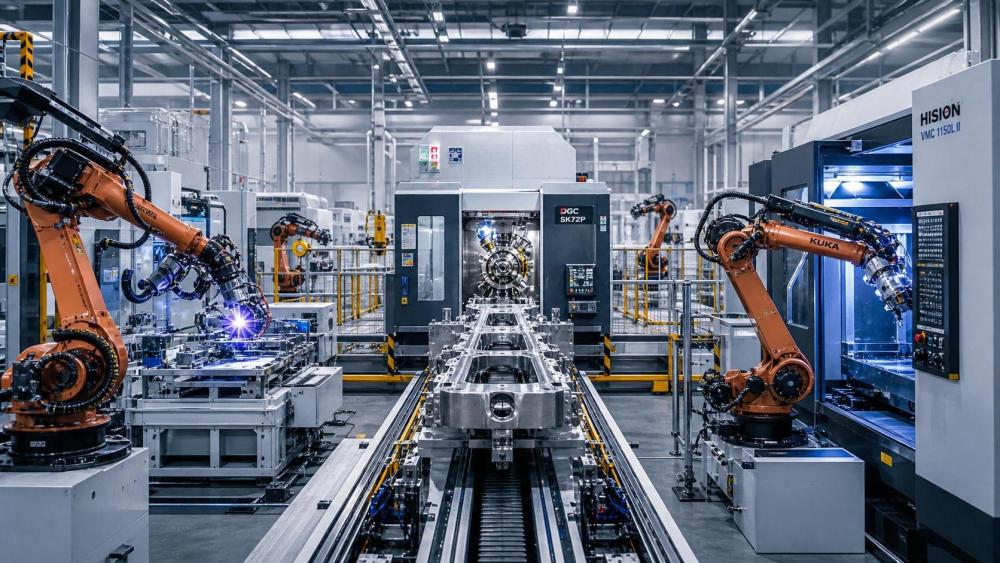
In 2026, robotics automation trends are no longer defined by robot counts alone.
The stronger signal is how automation is being woven across welding, machining, fastening, inspection, and material flow.
That shift matters because global production is under pressure from labor volatility, stricter quality demands, energy costs, and fragile supply chains.
As a result, robotics automation trends are moving beyond labor substitution toward system resilience, traceability, and process intelligence.
This is especially visible in sectors where physical connection and cutting quality decide downstream reliability.
Laser welding, robotic arc welding, CNC tool performance, smart torque tools, and structural fastening are becoming part of one automation conversation.
From the perspective of HTWS, the most meaningful change is not a single machine upgrade.
It is the tighter link between melt pool control, cutting precision, fastening integrity, and digital feedback across the factory floor.
Why the current wave is becoming harder to ignore
Recent demand patterns show that automation projects are being judged on flexibility as much as speed.
Facilities want cells that can handle mixed batches, changing materials, and tighter qualification requirements without long reprogramming cycles.
That is one reason robotics automation trends now favor modular workstations, machine vision, and software-defined workflows.
Another driver is the rising cost of defects in high-value production.
A missed weld, unstable torque value, or premature insert wear now creates more than scrap.
It can disrupt certification, delivery schedules, and customer confidence.
This is why real-time sensing has become central to robotics automation trends.
Factories increasingly want data from seam tracking, acoustic wear monitoring, power draw, vibration, and torque traceability in one decision loop.
- More product variants are forcing robots to adapt faster at the cell level.
- Skilled labor gaps are pushing automation into tasks once considered too nuanced.
- Energy and consumable costs are making process efficiency easier to quantify and harder to ignore.
- Traceability requirements are turning every weld, cut, and fastening cycle into a data asset.
The next gains will come from process-aware robotics, not just faster robots
One of the most important robotics automation trends for 2026 is process awareness.
Robots are being asked to react to material behavior, heat input, joint variation, and tool condition in real time.
In laser welding, this means more systems using sensors to stabilize penetration, reduce spatter, and manage dissimilar materials.
In robotic arc welding, visual seam tracking and coordinated positioners are reducing dependence on ideal part consistency.
In machining, acoustic and force signals are starting to influence tool life decisions before quality drifts appear.
The same logic is reaching power tools and fastening systems.
Smart torque sensing and digital tightening records are making assembly automation more defensible in regulated environments.
This broadens the meaning of robotics automation trends.
The robot is becoming one executor inside a monitored physical process, not the entire story.
Where that change is showing up first
Flexibility is overtaking pure throughput as a buying signal
For years, many automation investments were justified by volume.
That logic is changing because production planning is less stable than before.
Shorter runs, redesign cycles, and regionalized supply chains are changing what good automation looks like.
This is why robotics automation trends increasingly favor reconfigurable fixtures, collaborative programming tools, and portable automation formats.
The rise of handheld laser welders already showed how quickly lower barriers can reshape workflow design.
Now a similar expectation is reaching larger systems.
Users want robotic cells that are easier to redeploy between chassis parts, heavy steel components, battery enclosures, and fabricated subassemblies.
In practice, flexible automation also changes supplier evaluation.
Technical credibility now depends on process data, upgrade pathways, and compatibility with surrounding tools as much as headline cycle time.
The impact is spreading across the entire physical processing chain
A narrow view treats robotics automation trends as a welding or assembly topic.
A broader view shows that each automated step affects the next one.
If machining leaves unstable edge conditions, welding variability rises.
If fastening records are incomplete, final quality assurance becomes slower and less reliable.
This interconnectedness is where HTWS brings useful perspective.
Its focus on cutting tools, welding automation, power tools, and structural fasteners reflects how modern factories actually experience automation change.
The practical implication is that robotics automation trends should be reviewed across four linked layers.
- Process stability: heat, force, wear, and alignment control.
- Equipment interoperability: robots, sensors, tooling, and software working together.
- Quality traceability: usable records tied to each critical operation.
- Commercial resilience: exposure to rare metal shocks, consumable costs, and trade barriers.
Ignoring one of these layers often weakens the return from the other three.
What deserves closer attention before committing capital
Not every automation upgrade deserves equal urgency in 2026.
The stronger candidates are where physics, quality risk, and labor dependency converge.
That often includes deep penetration welding, high-mix fabricated assemblies, hard-material machining, and critical fastening steps.
More important, automation decisions should be tested against a narrower set of questions.
- Can the system adapt to part variation without repeated manual correction?
- Does it produce process data that supports root-cause analysis?
- Will tooling, consumables, and maintenance skills scale with deployment?
- Can the cell remain useful if volumes, materials, or compliance rules change?
These questions make robotics automation trends easier to evaluate in operational terms, not marketing terms.
They also reduce the common mistake of treating automation as a one-time equipment purchase.
The next move is to build a staged response, not chase every signal
The strongest response to robotics automation trends in 2026 is selective acceleration.
That means mapping where automation can protect quality, absorb volatility, and raise process visibility first.
It also means watching the surrounding signals that HTWS tracks closely.
Rare metal pricing, consumable supply risk, tool wear behavior, and fastening reliability all affect automation economics more than many forecasts admit.
A useful next step is to review one production chain end to end.
Compare current welding, cutting, tightening, and inspection performance against the data visibility needed for future scaling.
Then prioritize the gaps that limit flexibility or create repeated quality exposure.
Robotics automation trends are pointing toward smarter physical production, but the advantage will go to those who connect the process details early.
In 2026, the real competitive edge will come from seeing automation as a coordinated industrial capability, not a standalone machine category.