
How to Choose Digital Tool Life Management Software
Digital tool life management has moved from shop-floor administration to board-level operations strategy. In machining, welding, fastening, and powered assembly, tool condition now shapes uptime, scrap rates, traceability, and capital efficiency.
That shift matters because modern production systems are tighter and less forgiving. A worn insert, unstable welding tip, drifting torque tool, or overused cutter can trigger quality loss long before visible failure appears.
Choosing software for digital tool life management is therefore not only about monitoring wear. It is about building a reliable decision layer between machine data, maintenance timing, and production outcomes.
Why tool life visibility matters more now
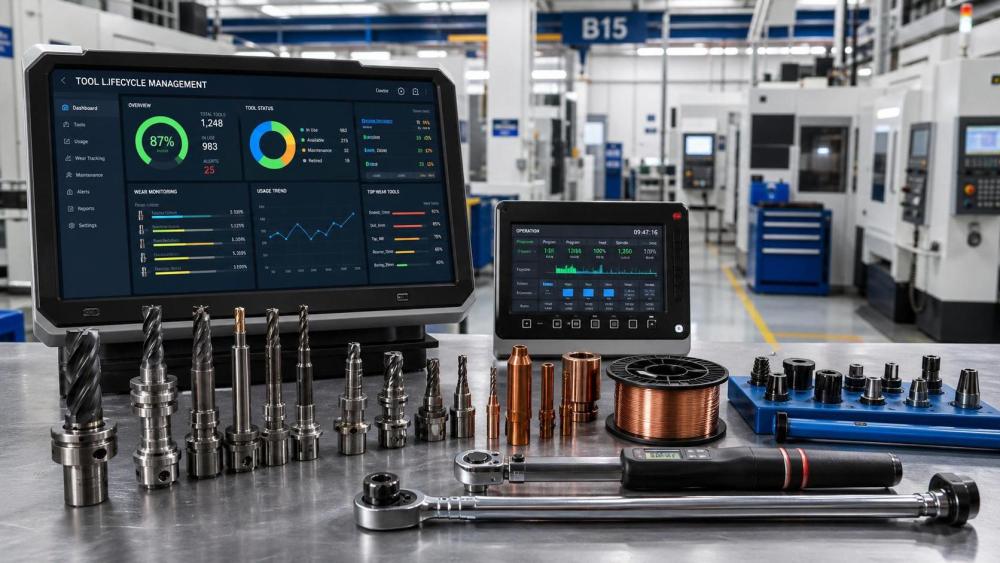
Across the HTWS focus areas, lifecycle pressure is rising. Laser welding systems demand stable process windows. Robotic arc cells depend on repeatable consumable performance. CNC tools face harder materials and faster cycles.
Power and pneumatic tools increasingly carry torque traceability requirements. Fastener-critical industries also expect stronger documentation around every tightening and joining event.
In that environment, digital tool life management helps connect physical wear to business decisions. It reduces the guesswork behind replacement intervals, spare planning, maintenance scheduling, and process risk.
The real value appears when software turns scattered signals into action. Instead of replacing tools too early or too late, operations teams gain a clearer model of useful life.
What the software should actually manage
At a basic level, digital tool life management software records identification, usage, wear status, and replacement history. A stronger platform does much more than maintain a digital logbook.
It should connect tool data to context. That includes machine type, material grade, shift pattern, cutting parameters, operator actions, and quality results.
For high-precision CNC environments, this often means tracking inserts, holders, offsets, cutting time, tool change counts, and wear alarms. In welding, it may extend to torch consumables, nozzle condition, contact tips, and seam consistency.
In smart assembly, the same logic applies to torque tools, battery cycles, calibration dates, and fastening trace records. Good software should support these differences without forcing every process into one rigid template.
A practical definition
Digital tool life management is the coordinated use of software, machine inputs, and operating rules to predict, control, and document the usable life of production tools and consumables.
That definition is important because many systems promise visibility, yet only a few support timely intervention and measurable improvement.
The selection decision starts with workflow fit
The first question is not feature count. It is whether the software matches how tools move through your operation.
Some sites manage centralized tooling rooms. Others rely on line-side kits, robot cells, mobile maintenance teams, or supplier-managed inventories. The software should reflect the actual handoff points.
If the process includes multiple plants, outsourced machining, or mixed equipment generations, digital tool life management must also support uneven data maturity. A system that only works in ideal conditions will stall during rollout.
Look closely at how the platform handles setup, issue, return, regrind, calibration, scrap, and audit trails. These daily movements determine whether data stays accurate.
Key workflow questions
- Can one tool record follow the item from purchase to disposal or reconditioning?
- Does the system support both automated and manual data capture?
- Can different plants use shared standards without losing local flexibility?
- Will operators and maintenance teams complete tasks with minimal extra input?
Data quality matters more than dashboard design
Many buyers are drawn to dashboards first. That is understandable, but visuals do not fix weak data foundations.
A reliable digital tool life management platform needs clear master data, stable naming rules, event timestamps, and disciplined exception handling. Without these, replacement forecasts will look precise while remaining operationally unreliable.
This is especially relevant in sectors tracked by HTWS, where tool behavior changes with metallurgy, heat input, coatings, vibration, and throughput intensity. The software should let teams segment life performance by real production variables.
It should also support integration with CNC controls, MES, ERP, quality systems, torque platforms, or welding cell controllers where available. Manual entry can work, but only if the burden stays realistic.
What strong data support looks like
The best choice depends on your operating scenarios
Different environments place different demands on digital tool life management. A single evaluation model rarely captures them all.
High-mix machining
Prioritize software that handles frequent setup changes, short batches, and complex tool assemblies. Predictive life estimates must adjust quickly when jobs change.
Automated welding cells
Look for links between consumable status, seam quality, and robot utilization. Cell stoppages often come from small components, not only major equipment.
Torque-critical assembly
Software should connect tool life, calibration, and fastening traceability. Here, an expired tool can become both a quality issue and a compliance issue.
Multi-site industrial groups
Standardization is essential, but so is local adaptability. Compare how the platform handles shared KPIs, plant-specific logic, and global reporting.
How to judge business value before purchase
The most useful evaluation is not feature-by-feature. It is outcome-by-outcome.
Estimate whether digital tool life management can lower emergency tool changes, reduce scrap, improve tool utilization, shorten setup delays, and strengthen planning confidence.
Also examine hidden costs. Integration effort, master data cleanup, user training, and ongoing rule maintenance can outweigh the license price if implementation is poorly scoped.
A good vendor should be able to show how the software performs in demanding physical processes, not only generic asset management examples.
Useful evaluation criteria
- Time to usable data after deployment
- Accuracy of life forecasts under variable conditions
- Ease of integration with existing industrial systems
- Support for traceability, audits, and quality investigation
- Scalability across plants, product lines, and tool categories
Common selection mistakes to avoid
One common mistake is treating digital tool life management as a narrow maintenance purchase. In reality, it crosses production, quality, planning, procurement, and engineering.
Another mistake is assuming all tools behave the same way. Cutting tools, welding consumables, and smart torque tools age differently and require different logic.
Some teams also overvalue artificial intelligence claims. Advanced analytics are useful, but only after workflows, tags, and data discipline are stable.
Finally, avoid selecting a platform that cannot explain decisions. When a system recommends replacement, users should see which signals drove that recommendation.
What a sensible next step looks like
Start with one tool family where wear affects output, quality, or downtime in a visible way. That may be carbide inserts, welding consumables, or torque tools with traceability demands.
Map the current lifecycle, identify missing data points, and define which decisions the software must improve. Then compare vendors against those operating realities, not against a generic checklist.
For organizations following HTWS sectors, the strongest software choice is usually the one that understands how physical processing, structural reliability, and tool economics interact across the full lifecycle.
When digital tool life management is chosen with that level of clarity, it becomes more than a monitoring tool. It becomes a practical system for protecting precision, continuity, and long-term manufacturing performance.