
Manufacturing Equipment Trends Analysis: Where Capex Is Moving Next
Manufacturing Equipment Trends Analysis: Why capital is shifting now
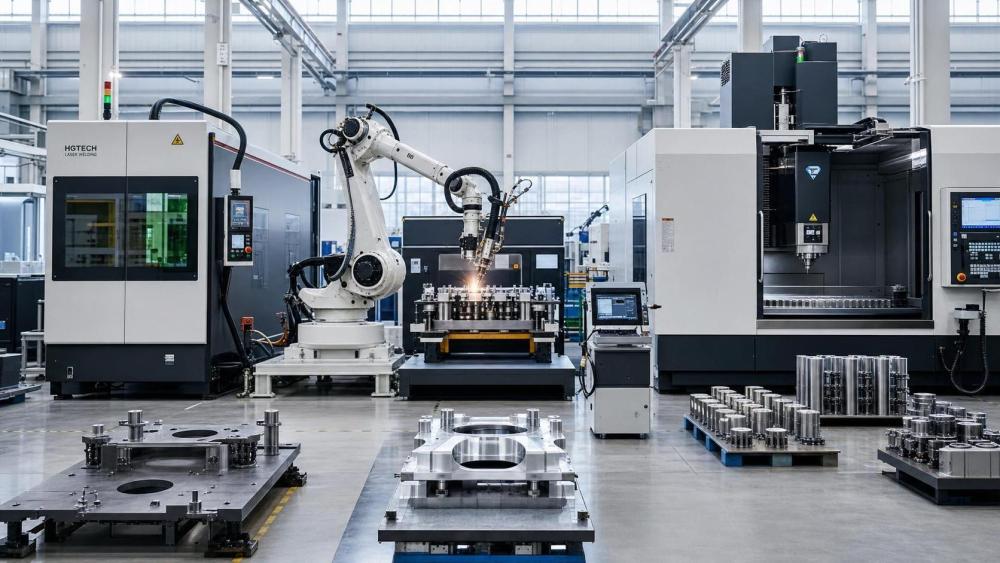
Manufacturing equipment trends analysis matters because equipment budgets are no longer driven by capacity alone.
The real shift is toward assets that improve precision, uptime, traceability, and resilience under unstable supply, labor, and energy conditions.
That is why spending is moving toward robotic arc welding cells, industrial laser systems, advanced CNC tooling, smart torque tools, and high-strength fastening systems.
In practical terms, buyers are asking a different question.
Not just, “What machine is cheaper today?”
More often, it becomes, “Which equipment protects output quality and margin over the next three to five years?”
This is where manufacturing equipment trends analysis becomes useful.
It helps separate short-lived hype from durable capex movement across cutting, joining, and structural assembly.
HTWS tracks this landscape closely because those five equipment pillars increasingly determine how modern factories compete at the process level.
What does manufacturing equipment trends analysis actually reveal?
A good manufacturing equipment trends analysis does not stop at market size charts.
It shows where spending is becoming more selective and what technical outcomes justify that spending.
Several signals stand out across global manufacturing.
- Automation is favored when skilled labor shortages directly affect weld consistency, cycle time, or rework rates.
- Precision upgrades gain priority when materials become harder, thinner, lighter, or more expensive to waste.
- Connected tools attract budget when quality documentation is required by export, aerospace, rail, or energy standards.
- Durability-related components gain value when downtime costs exceed the initial price difference.
That explains the strong attention on laser welding machines.
They support thin materials, dissimilar metals, cleaner seams, and faster changeovers.
It also explains why robotic arc welding workstations remain attractive in heavy steel applications.
Repeatability, seam tracking, and integrated positioners turn labor instability into a more controllable process variable.
CNC cutting tools are another part of the story.
When powder metallurgy, nano-coatings, and wear monitoring reduce scrap and extend insert life, capex logic changes quickly.
Where is capex moving next across the five equipment pillars?
The next wave is not moving evenly.
Capital is flowing toward equipment categories that solve measurable bottlenecks.
The table below summarizes how manufacturing equipment trends analysis is being interpreted in current evaluations.
The pattern is clear.
Capex is moving toward equipment that can prove process control, not simply promise output improvement.
How should equipment be compared when several technologies look attractive?
This is where many comparisons go wrong.
A manufacturing equipment trends analysis is useful only if it is connected to the actual production constraint.
For example, replacing a conventional welding setup with a robotic cell makes sense when defect variation and labor dependency are the main losses.
It makes less sense when upstream part inconsistency is still unresolved.
The same applies to CNC tooling.
Premium inserts can improve economics dramatically, but only when spindle stability, coolant delivery, and workholding quality are already stable.
A practical comparison usually includes four layers.
- Process fit: material type, tolerance, thickness, duty cycle, and batch variability.
- Financial fit: total ownership cost, consumables, maintenance, and payback sensitivity.
- Operational fit: training burden, operator acceptance, digital traceability, and spare-part access.
- Strategic fit: export requirements, tender credibility, and future automation compatibility.
HTWS often highlights this broader lens.
Its intelligence focus on welding physics, tool wear signals, and fastener torque decay reflects what serious comparisons increasingly demand.
What mistakes distort manufacturing equipment trends analysis?
The most common mistake is treating all automation spending as equally valuable.
In reality, some automation removes waste, while some only relocates it.
Another mistake is underestimating the role of consumables and structural components.
Capex discussions often focus on machines, yet cutting tools, torque tools, and fasteners strongly influence lifecycle performance.
There is also a timing error.
Some buyers wait for a full plant overhaul, when a targeted upgrade would solve the cost problem earlier.
More specific risk signals should be checked before a final decision.
- Imported consumable exposure to metal price shocks or trade barriers
- Traceability gaps that could block qualification in regulated sectors
- Mismatch between equipment speed and downstream inspection capacity
- Service networks that look adequate on paper but weak in local response time
- Pilot data based on ideal samples rather than real production variation
In short, manufacturing equipment trends analysis should test operating reality, not presentation quality.
Which signals deserve the closest watch over the next cycle?
A few indicators are becoming more predictive than headline demand numbers.
One is whether equipment can document quality automatically.
That matters for smart torque tools, robotic welding logs, and tool wear monitoring alike.
Another is adaptability.
Handheld laser welding gained attention partly because it lowered the barrier to process change in smaller or mixed-volume operations.
A third signal is structural reliability over time.
Fastener preload retention, vibration resistance, and torque decay behavior are no longer niche engineering concerns.
They now influence how long expensive assemblies stay in service without corrective work.
This is also why more teams are paying attention to intelligence sources that connect process science with commercial movement.
When rare metal pricing, welding automation demand, and carbide wear data are reviewed together, capex direction becomes easier to judge.
So what is the practical next step before budget decisions are locked?
A strong manufacturing equipment trends analysis should end with a shortlist, not with a vague trend summary.
Start by mapping the largest cost of poor performance in the current process.
Then test whether the answer is automation, precision tooling, smarter fastening control, or a combination.
It also helps to build a simple evaluation sheet covering process fit, traceability, consumable exposure, implementation speed, and service readiness.
That approach keeps capex grounded in operating evidence.
The broader market direction is already visible.
Investment is moving toward equipment that makes cutting, joining, and assembly more measurable, more repeatable, and less vulnerable to disruption.
The next useful step is to compare those signals against actual production priorities, then narrow the field using quantified trials and lifecycle benchmarks.
- robotic arc welding workstations
- pneumatic tools
- high-strength fasteners
- welding automation
- CNC cutting tools
- arc welding
- Power and Pneumatic Tools
- Seam Tracking
- Tool Wear Monitoring
- Structural Assembly
- industrial laser systems
- Welding Workstations
- Welding Cells
- Powder Metallurgy
- Manufacturing Equipment Trends
- manufacturing equipment trends analysis
- fastener torque decay
- robotic arc welding
- smart torque tools