
Precision Machining Germany: What Sets Top Suppliers Apart
Why does precision machining Germany still matter in supplier selection?
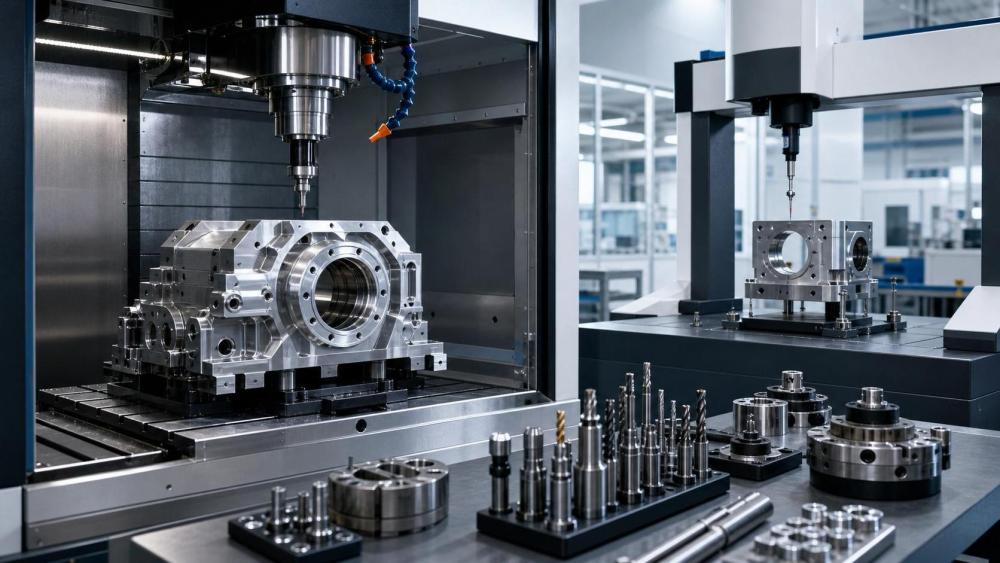
When shortlists are built for critical components, precision machining Germany often appears early for a reason.
The market is associated with disciplined engineering, stable process control, and strong manufacturing documentation.
That reputation helps, but reputation alone does not protect a project.
What matters more is whether a supplier can repeat tolerance performance, manage complex materials, and keep quality visible across the full production cycle.
In practical terms, top suppliers in precision machining Germany stand out because they connect machining, inspection, tooling, and downstream assembly logic.
That is especially relevant for sectors linked to welding systems, structural fastening, industrial tools, and high-load assemblies.
HTWS often tracks this wider manufacturing chain.
A machined part is rarely evaluated in isolation.
Its surface finish can influence weld preparation, its dimensional stability can affect torque accuracy, and its material behavior can shape fastener life.
So the better question is not simply who can machine a part.
It is who can machine it consistently within a larger industrial system.
What separates a top German machining supplier from an average one?
The biggest difference is process reliability under production pressure.
A capable shop can produce a good sample.
A top supplier can keep that result stable across batches, material lots, and schedule changes.
This usually shows up in five areas:
- Clear control of tolerance chains, not just single dimensions.
- Material knowledge covering stainless steel, aluminum alloys, hardened steels, titanium, and specialty grades.
- Tooling strategy that supports repeatability, cycle balance, and wear prediction.
- Inspection systems with traceable records, calibration discipline, and measurable reaction plans.
- Delivery planning that protects deadlines without quietly relaxing process standards.
More mature suppliers also understand how machining choices affect later operations.
For example, edge condition may influence robotic welding quality.
Hole accuracy may determine fastener preload stability.
Surface integrity may shape coating adhesion or fatigue behavior.
That broader awareness is often where precision machining Germany gains its strongest practical advantage.
How can you tell whether the claimed capability is real?
Brochures usually sound similar.
The useful signals come from evidence, not slogans.
A quick way to structure review is to check the questions below.
This is where site visits, sample reviews, and technical calls become useful.
Ask how deviations are detected early.
Ask who owns corrective actions.
Ask what changes when demand doubles.
The answers usually reveal whether precision machining Germany is being delivered as a real system or used as a label.
Which applications benefit most from precision machining Germany?
Not every part needs premium process depth.
The value is highest when failure costs are large or interfaces are demanding.
Typical examples include:
- Components for automated welding equipment where fit-up accuracy affects seam quality.
- Tooling bodies and holders used with high-performance CNC cutting systems.
- Parts exposed to vibration, torque cycling, or structural preload conditions.
- Assemblies using high-strength industrial fasteners with narrow dimensional allowance.
- Low-to-medium volume engineered parts where process repeatability matters more than lowest unit price.
In these cases, defects often travel downstream.
A machining issue may not appear until welding distortion, misalignment, leak testing, or field loading begins.
That is why HTWS tends to view machining, welding, tools, and fastening as one connected industrial logic.
The more the final product depends on connection strength and dimensional integrity, the more precision machining Germany becomes relevant.
Where do evaluation teams make the wrong call?
A common mistake is treating sample success as production proof.
Another is comparing quotes without aligning specifications, inspection depth, and delivery assumptions.
Price gaps often reflect hidden scope differences.
There is also a tendency to focus on machine lists.
Modern equipment matters, but programming discipline, fixture design, tool monitoring, and operator response matter just as much.
More subtle risks appear in documentation control.
If revision handling is weak, even an experienced shop can produce a technically correct but commercially unusable batch.
Lead time assumptions also deserve caution.
Precision machining Germany can involve specialized fixtures, approved subcontractors, coating schedules, or heat treatment windows.
Those dependencies should be visible before commitment.
A more reliable approach is to assess total execution risk, not only unit cost.
What should be confirmed before moving to nomination or trial order?
At this stage, clarity matters more than volume promises.
The goal is to confirm whether the supplier can scale without losing control.
- Lock the drawing revision, material grade, and acceptance criteria.
- Define which dimensions are critical to function and which are cosmetic.
- Confirm inspection frequency, report format, and retention period.
- Map external processes such as heat treatment, coating, grinding, or marking.
- Review packaging, corrosion protection, and transport conditions.
- Set deviation communication rules before serial production begins.
This is also the right point to ask for lessons from similar parts.
Strong suppliers usually discuss machining strategy, risk areas, and expected control points with little prompting.
That depth is often a better sign than broad marketing language.
When reviewing precision machining Germany options, the best decisions usually come from structured comparison, not fast assumptions.
Start with the application, test the process evidence, and verify how machining quality supports welding, tooling, fastening, and final assembly outcomes.
That creates a more defensible shortlist.
It also makes next steps clearer: refine the technical requirement, compare process transparency, and validate delivery risk before expanding order scope.